

One of your best salespeople just got promoted to manager. Three months later, team targets are down, two people have quit, and they look more stressed than ever.
What went wrong? Probably not the person. The decision.
A bad promotion decision happens when someone is elevated to a new role based on performance in their previous role, rather than behavioral readiness for the demands of the new one. It’s one of the most expensive — and most common — people decisions companies get wrong.
The logic seems obvious: the best salesperson should lead the sales team. The strongest engineer should become the lead engineer.
But being a top performer and being a leader are two very different things.
Being a top performer requires execution focus, strong individual capability, and drive toward personal targets. Being a leader requires something almost opposite: the ability to let go of control, a focus on developing others, and comfort with the ambiguity that comes from managing people — not numbers.
Someone exceptionally strong in one area isn’t automatically strong in the other.
A few patterns tend to show up before a promotion eventually runs into trouble:
• Promoted because they’ve “been there the longest” — not because their behavioral patterns actually fit leadership
• No separate evaluation — between technical competence and behavioral readiness to lead
• Assuming leadership skills will “develop naturally” — once someone is given the title
• No comparative data — the decision rests purely on subjective impression or seniority
If any of these sound familiar, it might be worth re-examining how promotion decisions are made in your organization.
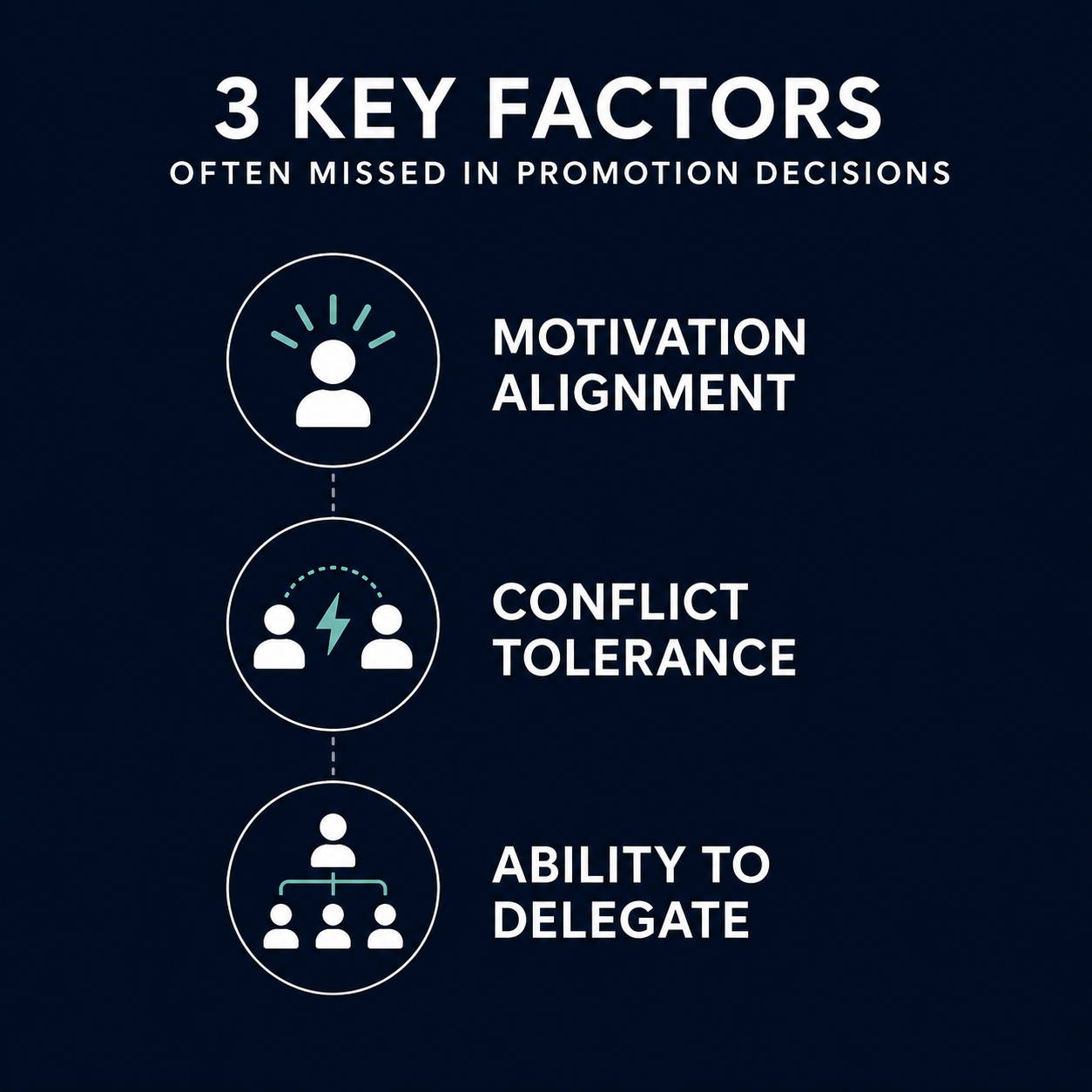
What makes high-risk promotions fail isn’t usually a lack of effort — it’s that a few things rarely get considered beforehand:
Different motivations at different levels
Someone motivated by individual achievement isn’t necessarily motivated by collective team success — yet that’s exactly what leadership roles require.
Tolerance for conflict and ambiguity
Leading a team means dealing with friction, decisions that aren’t black and white, and situations without a clear answer. Not everyone is comfortable in this space — and that’s not a flaw, just a mismatch.
The ability to let go of control
Many top performers succeed because they do everything themselves with high precision. Becoming a leader means trusting others to do the same work — something that doesn’t come naturally to everyone.
Promotions don’t have to be guesswork. A few steps that help:
Separate skill evaluation from leadership readiness evaluation
Technical competence shows someone is excellent at their craft. It doesn’t automatically show they’re ready to lead other people.
Look at behavioral patterns, not just work output
Work output shows what someone has already achieved. Behavioral patterns show how someone is likely to act in situations they haven’t faced before — like leading a team for the first time.
Use data as a discussion input, not the final decision
Behavioral data helps open a more honest conversation about someone’s readiness — not to replace human judgment, but to complement it with a more objective perspective.
Cavlent helps organizations see someone’s behavioral readiness for a leadership role — before the promotion decision is made, not after problems surface.
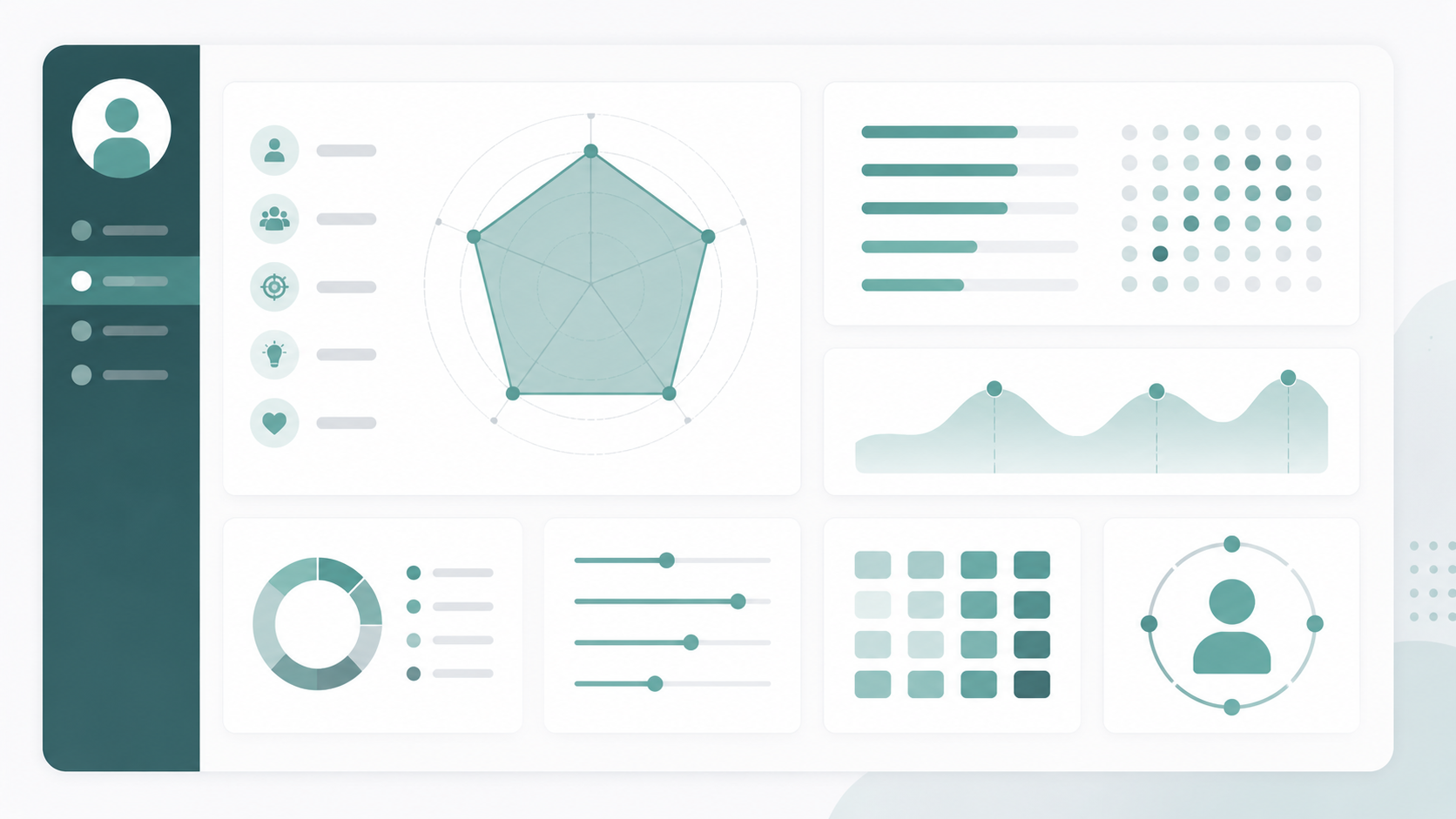
By mapping dominant motivation, collaboration patterns, and how someone responds to ambiguous situations, behavioral mapping data provides a more complete picture of someone’s readiness for a new role — complementing what’s already visible from their track record.
→ Explore Cavlent’s solutions for leadership development and succession planning
You might also find these useful:
→ Case study: behavioral mapping for leadership gap identification
→ What made you successful might be slowing you down now
→ The real cost of a bad hire: what companies are losing
Why isn’t your best-performing employee always your best future leader?
Because being a top performer in an individual role requires different capabilities than leadership. Top performers typically excel at execution and personal target achievement, while leaders need the ability to let go of control, focus on developing others, and tolerate ambiguity.
What’s the biggest risk of a bad promotion decision?
Beyond declining team performance, a bad promotion can cause turnover among team members, excessive stress on the promoted individual, and indirect costs from time spent fixing the situation — all of which can be far more expensive than the cost of re-recruitment.
How do you know if someone is ready for a leadership position?
Look at three things: their dominant work motivation (does it align with team success, not just individual achievement?), their tolerance for conflict and ambiguity, and their ability to let go of control and trust others. Behavioral mapping helps measure all three more objectively.
What is succession planning and why does it matter?
Succession planning is the process of identifying and developing an organization’s future leaders in a planned, deliberate way — rather than reactively when a position suddenly opens up. It matters because organizations without a succession plan risk making rushed, under-considered promotion decisions.
Can behavioral mapping predict whether someone will succeed as a leader?
Behavioral mapping doesn’t predict with certainty, but it provides objective data on behavioral tendencies relevant to leadership demands. This data helps reduce the risk of mismatch — it doesn’t guarantee success, but it makes promotion decisions far more informed than relying on past performance alone.