A bad hire is what happens when a new employee fails to deliver the expected contribution — or actively disrupts the team dynamic they’ve joined. The damage isn’t limited to poor performance. It shows up in wasted time, unexpected costs, and a gradual erosion of team morale that’s easy to miss until it’s already widespread.
Ever hired someone who seemed like a perfect fit in the interview — only to find the team quietly exhausted three months later trying to cover for them? If so, you’re not alone. And the cost is almost always larger than it first appears.
It’s Not Just the Salary
Most people assume the damage from a bad hire is limited to the salary paid during that person’s tenure. But that’s just the surface. Here’s what often gets missed:
• Re-recruitment costs — reposting the role, screening hundreds of applications, running interviews again, onboarding from scratch
• Management time lost — coaching, follow-ups, and handling the friction that one mismatched person creates across the team
• Productivity drag — colleagues absorbing the gap, projects slipping, deadlines missed
• Team morale erosion — the hardest thing to measure, and the most deeply felt
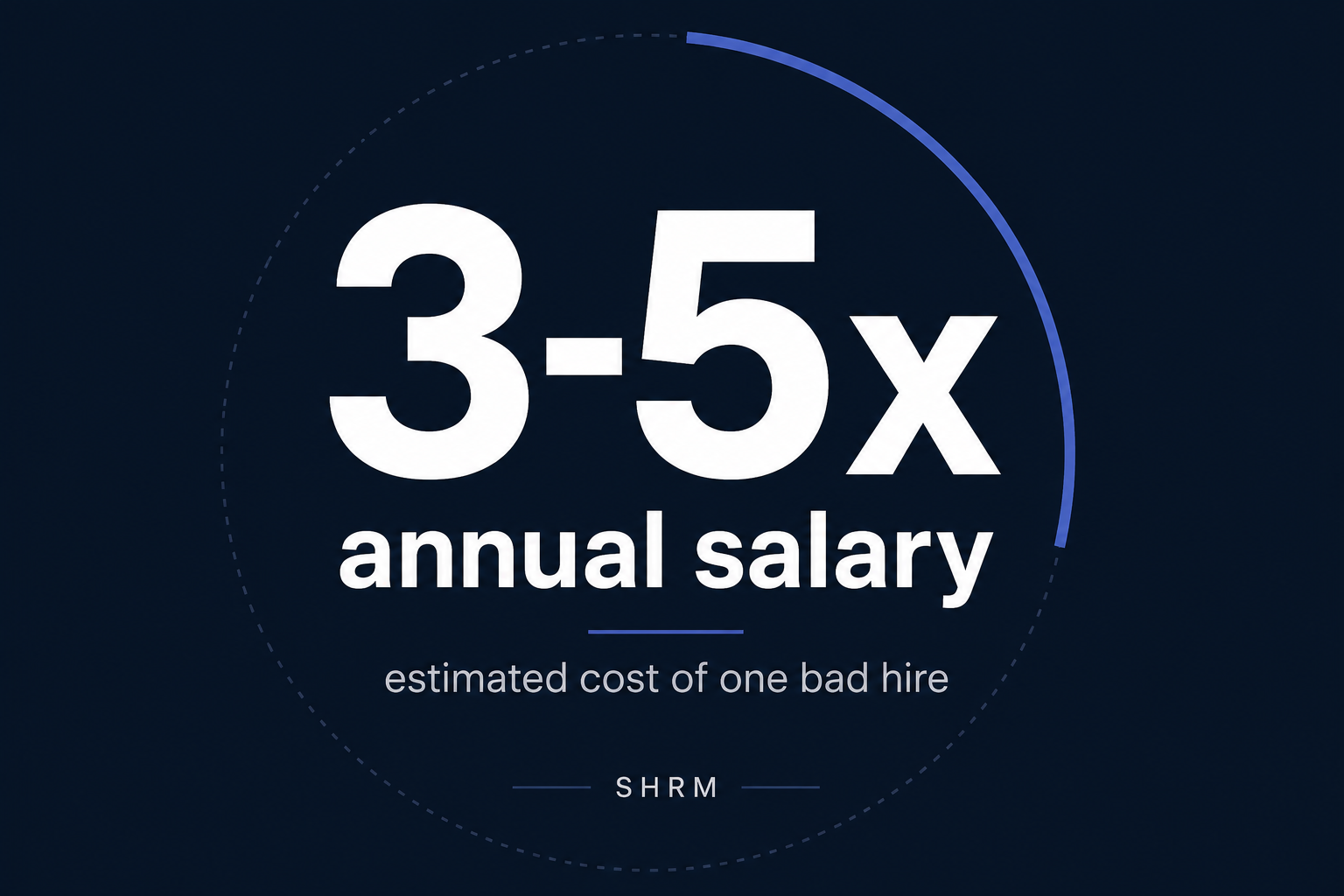
Research from the Society for Human Resource Management (SHRM) estimates the cost of a single bad hire can reach 3 to 5 times the annual salary of the role. For senior or managerial positions, the number climbs even higher.
The Problem Isn’t the Person
Here’s what often gets misread: a bad hire isn’t always a “bad” person. Many cases involve genuinely talented people who simply didn’t fit the team they joined.
Someone highly detail-oriented might thrive in an analytics team but create friction in a sales environment that runs on speed. Someone who does their best work independently might struggle in a team where collaboration is the default mode.
These mismatches are difficult to catch from a CV and a few rounds of interviews alone.
What You Can’t See Before They Join
A strong interview process can uncover experience and technical capability. But there’s one thing interviews consistently struggle to reveal: how someone actually behaves under real pressure.
These questions only get answered after the person is in the role — and by then, the costs are already accumulating.
Prevention Is Cheaper Than Recovery
Behavioral mapping exists to close this gap. Not to replace human judgment or instinct — but to supplement it with more objective data before a decision is made.
By understanding a candidate’s behavioral patterns and comparing them with the existing team’s dynamics, hiring decisions can be made on significantly stronger ground.
The result? Fewer surprises after onboarding. Less time lost to mismatches. Fewer costs that shouldn’t have been necessary in the first place.
Cavlent helps companies understand the behavioral patterns of candidates and teams before hiring decisions are made — in under 20 minutes, with same-day insight. Learn how behavioral mapping can help prevent bad hires in your organization.
→ Explore Cavlent's Solutions for Hiring & People Management
You might also find these useful:
→If every company problem is always the team's fault — maybe the real issue isn't the team
→Real case study: how behavioral mapping identified role mismatches at SPV and Manager level
→ How to read a Cavlent behavioral mapping report for candidate screening
Frequently Asked Questions
What is the average cost of a bad hire?
According to SHRM, a single bad hire can cost between 3 and 5 times the annual salary of the role — not including indirect costs like reduced team morale, delayed projects, or the management time absorbed by the situation.
What causes bad hires in the first place?
The most common cause isn’t a lack of competence — it’s a mismatch between how a candidate naturally works and how the existing team operates. This behavioral fit is difficult to assess through interviews or technical tests alone.
How can companies prevent bad hires?
Beyond structured hiring processes, behavioral mapping helps companies understand a candidate’s working patterns and compare them against the team’s existing dynamics — before the final decision is made.
Do bad hires only happen at junior levels?
No. Bad hires are actually more expensive at senior and managerial levels, because the impact spreads to more people and influences more strategic decisions.
What’s the difference between a bad hire and an underperformer?
Underperformance can often be addressed through coaching or training. A bad hire reflects a deeper mismatch — in behavioral style, values, or working approach — that typically doesn’t change with intervention.