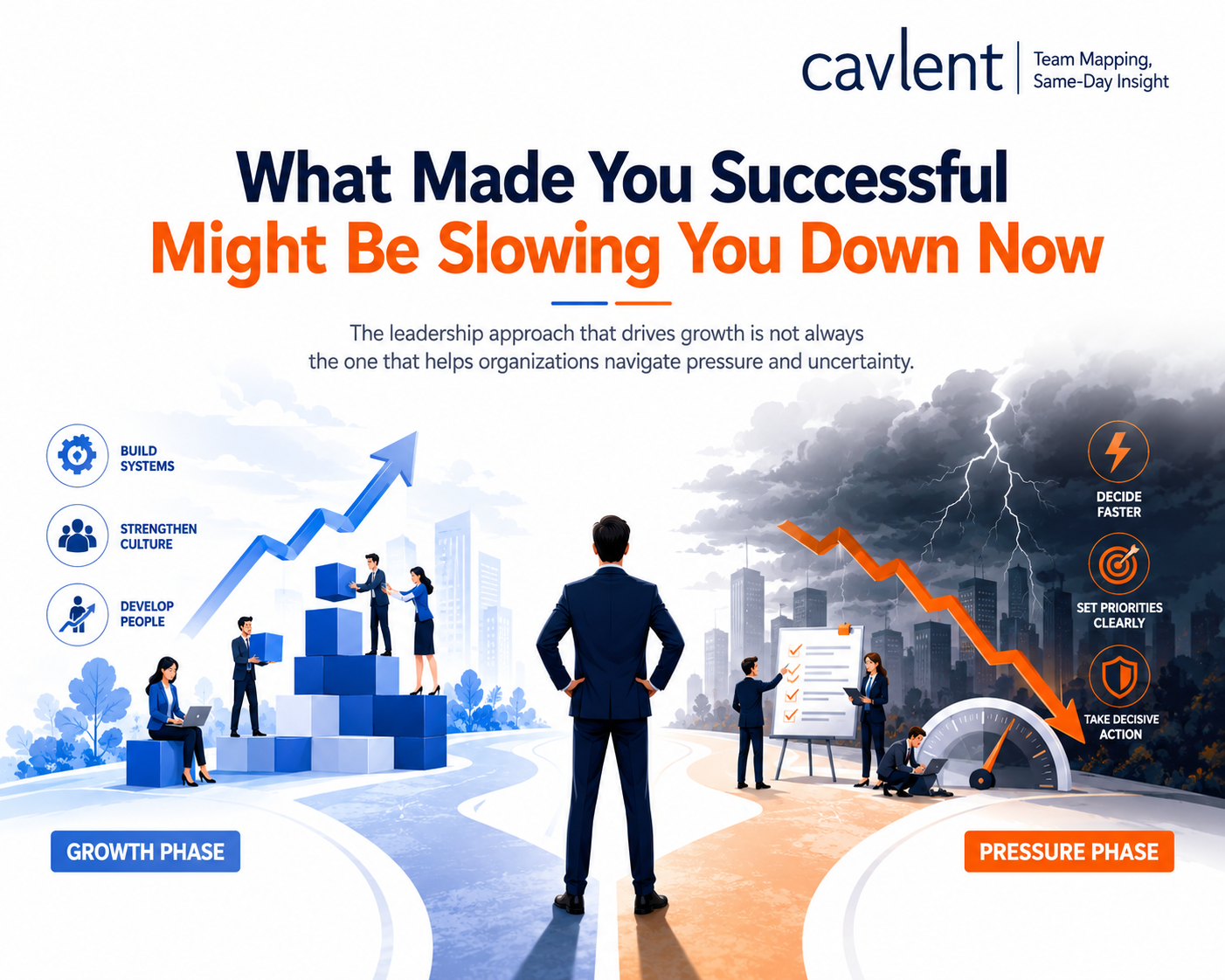
Business leaders often assume that the leadership style that helped a company grow will continue to work in every situation. Unfortunately, that is not always true.
As organizations evolve, markets shift, competition intensifies, and economic pressures increase, the leadership capabilities that were once highly effective may become less relevant. In some cases, what made a business successful during a growth phase can actually slow decision-making and adaptation during periods of uncertainty.
Leadership Needs Change as Business Conditions Change
When a business is growing steadily, organizations often benefit from leaders who focus on:
These leadership qualities create a strong foundation for sustainable growth. They help organizations scale without losing direction and ensure that success is not dependent on a few individuals. However, business conditions do not always remain stable.
Growth Phase vs Pressure Phase
When organizations enter a more challenging environment, the priorities often shift. Revenue may slow down. Cash flow may become tighter. Competitors may become more aggressive. Market conditions may become less predictable.
During these periods, organizations frequently need leaders who can:
This does not mean one leadership style is better than another. It simply means different situations require different leadership approaches.
The Mistake Many Organizations Make
One of the most common leadership mistakes is expecting a single leadership style to fit every business situation. As the context changes, leadership expectations should also evolve. For example:
The problem is not necessarily the leader. The problem is often the mismatch between the organization’s current challenges and the leadership approach being applied.
Cavlent helps leaders and organizations understand behavioral patterns, leadership dynamics, and transformation readiness through behavioral team mapping — with same-day insight.
→ Explore Cavlent's solutions for leadership and organizational transformation
You might also find these useful:
→ When economic pressure rises — why organizational culture determines business resilience
→ How to see your organization more completely: forest and tree at the same time
→ Case study: behavioral mapping to identify leadership gaps in a team
Leadership Is Not About Who Is Better
Organizations frequently compare leaders as if there is a universally “best” leadership style. In reality, leadership effectiveness is highly contextual. The better question is not: “Who is the better leader?”. The better question is: “Who is the most relevant leader for the situation we are facing right now?”
The answer may change as business conditions change.
Why Leadership Challenges Are Often Invisible
Leadership challenges are rarely obvious from the outside. When business performance changes, most people focus on financial metrics, operational issues, or market conditions.
What is often overlooked is the human side of transformation. As organizations grow or face pressure, team dynamics, motivation, communication patterns, decision-making behaviors, and cultural expectations also change.
This is why leadership effectiveness cannot be evaluated in isolation. It must be understood within the context of the organization’s current reality.
The Role of Data in Leadership and Organizational Transformation
Many organizations rely on assumptions, personal opinions, or subjective observations when evaluating leadership effectiveness. The risk is that leaders may be solving the wrong problem.
Before making major leadership, organizational culture, or talent decisions, companies need a clearer understanding of what is actually happening inside the organization. This is where behavioral and organizational mapping become valuable.
How Cavlent Helps Organizations Navigate Change
For business owners, executives, HR leaders, and transformation teams, understanding organizational dynamics is no longer optional.
Cavlent is a transformation navigator that helps organizations make better people and culture decisions through behavioral-based team mapping.
Using same-day insights, Cavlent helps organizations identify:
Instead of relying solely on intuition, organizations gain objective insights that support faster and more accurate decision-making. Because successful transformation starts with accurate diagnosis. And sometimes, what made an organization successful in the past is not what it needs most for the future.
Frequently Asked Questions
Why can a leadership style that worked in the past become a barrier today?
Because the business context changes, but leadership patterns often don’t change with it. An approach that was effective during stable growth isn’t necessarily relevant when the organization faces pressure, uncertainty, or a need for transformation. What made someone successful isn’t just their capability — it’s how relevant that capability is to the situation currently at hand.
How do I know if my leadership style is still relevant to my organization’s current needs?
Ask yourself: are decisions getting faster or slower? Is the team becoming more independent or more dependent? Is communication getting clearer or is miscommunication increasing? If the answers lean toward the second option, there’s a good chance the current leadership approach no longer fits what the organization needs.
What does “a mismatch between leadership approach and organizational context” actually mean?
It’s when the way a leader works, makes decisions, and interacts with the team is no longer aligned with what the organization needs at this stage. For example, a leader accustomed to full delegation can become a bottleneck in a situation that requires fast, centralized decisions.
Can behavioral mapping data help leaders understand their own blind spots?
Yes. One of the core values of behavioral mapping is helping individuals see their behavioral patterns more objectively — including tendencies so ingrained they’re no longer consciously noticed. Leadership blind spots are almost always invisible from the inside, and external data helps open perspectives that are hard to gain from self-reflection alone.
What’s the difference between opinion-based and behavioral data-based leadership evaluation?
Opinion-based evaluation is prone to bias — who’s liked, who appears active, or who speaks the most. Behavioral data-based evaluation looks at more consistent patterns: how someone actually works, gets motivated, and interacts — not just how they come across in specific moments.