When the Indonesian rupiah weakens, operating costs rise, raw material prices become more volatile, and market pressure intensifies. In response, many organizations immediately focus on adjusting their business strategy.
But in reality, strategy alone is rarely what determines whether a company can withstand difficult times. What often makes the difference is the organization’s internal readiness. Because during periods of uncertainty, businesses are not only testing their strategy. They are also testing their leadership effectiveness, organizational culture, and team adaptability.
Why Do Some Businesses Remain Stable During Difficult Times?
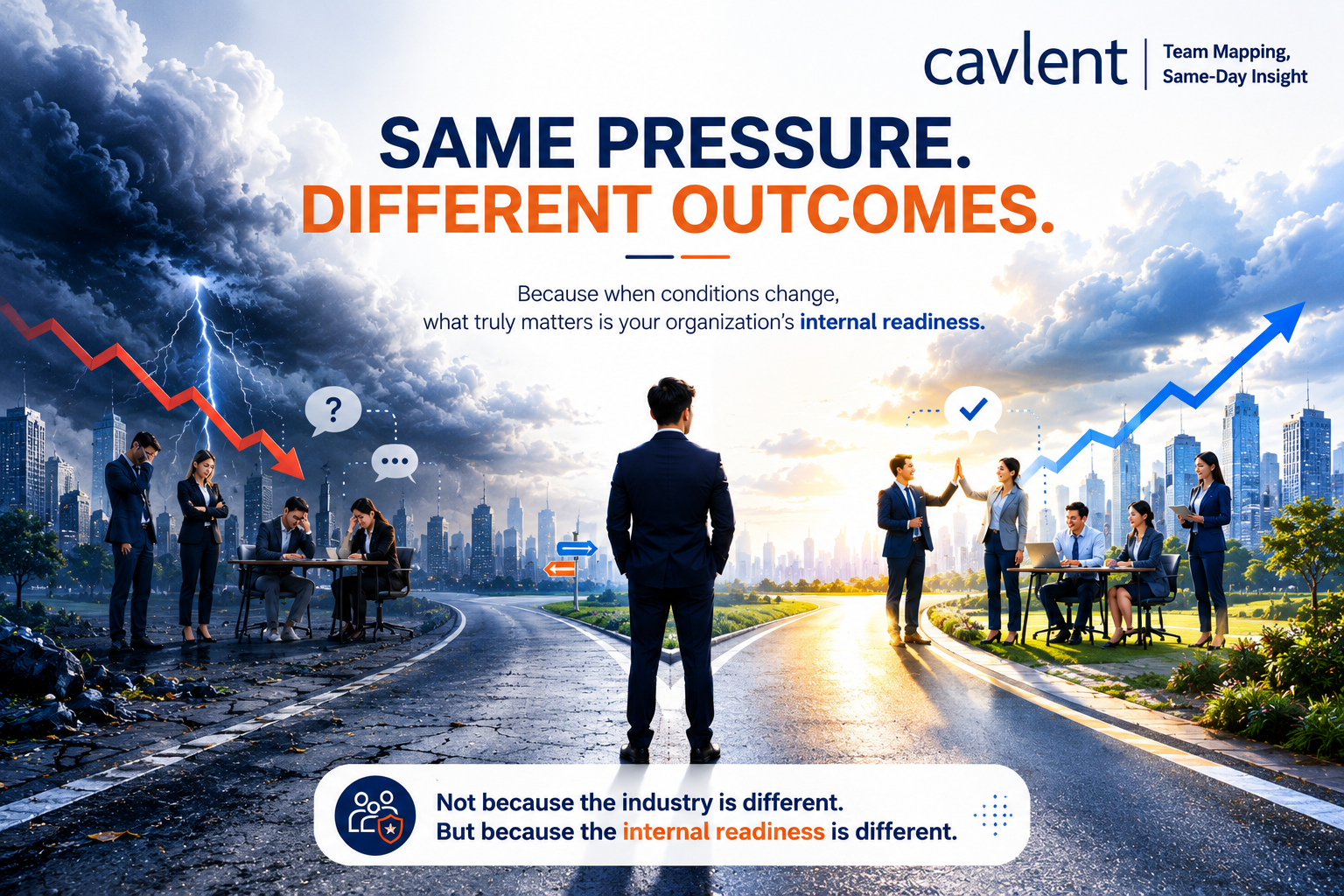
Under the same economic conditions, different organizations often produce very different outcomes. Some companies continue moving forward despite growing pressure. Others begin to experience:
Interestingly, the difference is often not the industry itself. The real difference lies in the organization’s internal strength—the systems, culture, and people capabilities that were built long before the pressure arrived.
Leadership Needs Change When Business Conditions Change
During periods of stable growth, organizations typically need leaders who can:
However, when business conditions become more challenging, organizational needs often shift. Situations such as declining revenue, cash flow pressure, economic uncertainty, or increased competition usually require leaders who can:
This is why effective leadership is not about having one leadership style that works everywhere. It is about having the leadership approach that is most relevant to the situation the organization is facing.
Strong Organizational Culture Is Often Invisible
One of the biggest challenges in organizational culture is that its impact is not always visible from the outside. Two companies can appear equally successful. Yet when external pressure increases, the differences begin to emerge.
Organizations with stronger cultures often demonstrate:
Meanwhile, organizations with weaker foundations may experience:
This is why business resilience is not determined solely by financial performance. It is also determined by the quality of the people systems operating behind the scenes.
Cavlent helps organizations understand their internal team and leadership readiness through behavioral team mapping — before external pressure becomes a crisis that's hard to manage. Same-day insights for faster, more objective decisions.
→ Learn how Cavlent helps organizations navigate change
You might also find these useful:
→ Why the strengths that made you successful may be slowing your organization down today
→ If every company problem is always the team's fault — maybe the real issue isn't the team
→ Case study: how behavioral mapping data helps when organizational change stalls
Why Organizational Assessment Matters
Many leaders only recognize organizational issues after they have already affected business performance. The reality is that most organizational challenges begin as hidden patterns long before they become visible problems. That is why organizational assessment, culture assessment, and behavioral team mapping have become increasingly important for modern organizations.
A proper assessment helps leaders understand:
Because meaningful transformation almost always starts with an accurate diagnosis.
How Cavlent Helps Organizations Navigate Change
Cavlent helps organizations gain a clearer understanding of their people dynamics through behavior-based team mapping and organizational assessment.
Using a behavioral approach, organizations can identify:
With same-day insights, leaders can make faster, more objective decisions without waiting weeks for traditional assessment processes. Because when external pressure increases, internal strength is no longer just an advantage. It becomes the foundation that determines whether a business can adapt, remain resilient, and continue growing.
Frequently Asked Questions
Why does organizational culture determine business resilience when the economy is under pressure?
Because when external pressure rises, what gets tested isn’t just the business model — it’s the ability of the people inside the organization to adapt, collaborate, and make decisions under uncertainty. Organizations with strong cultures tend to have clearer communication, healthier collaboration, and stronger alignment — all of which become real competitive advantages when conditions get difficult.
Does a leadership style that worked during growth always remain effective under pressure?
Not always. During stable growth, organizations need leaders who build systems and develop people. When pressure increases, the need shifts to leaders who make decisions faster, set priorities more decisively, and keep the team focused. Effective leadership is leadership that’s relevant to the context the organization is currently facing.
What are the signs that an organization is underprepared for economic pressure?
Common indicators include: slower decision-making, increasing miscommunication, growing dependency on specific individuals, teams burning out quickly, and organizational focus beginning to fragment. These signs typically emerge as patterns long before they impact business performance.
What is organizational assessment and why does it matter before a crisis hits?
Organizational assessment is a systematic process for understanding an organization’s internal condition — including communication patterns, team adaptability, cross-functional alignment, and hidden cultural risks. It matters before a crisis because most organizational problems appear as detectable patterns long before they become crises that are hard to manage.
How does behavioral mapping help organizations navigate economic uncertainty?
Behavioral mapping provides objective data about an organization’s internal readiness — not just from a strategy perspective, but from the perspective of the people executing that strategy. By understanding team behavioral patterns, leadership dynamics, and hidden collaboration risks, organizations can make faster and more accurate decisions when pressure rises.