
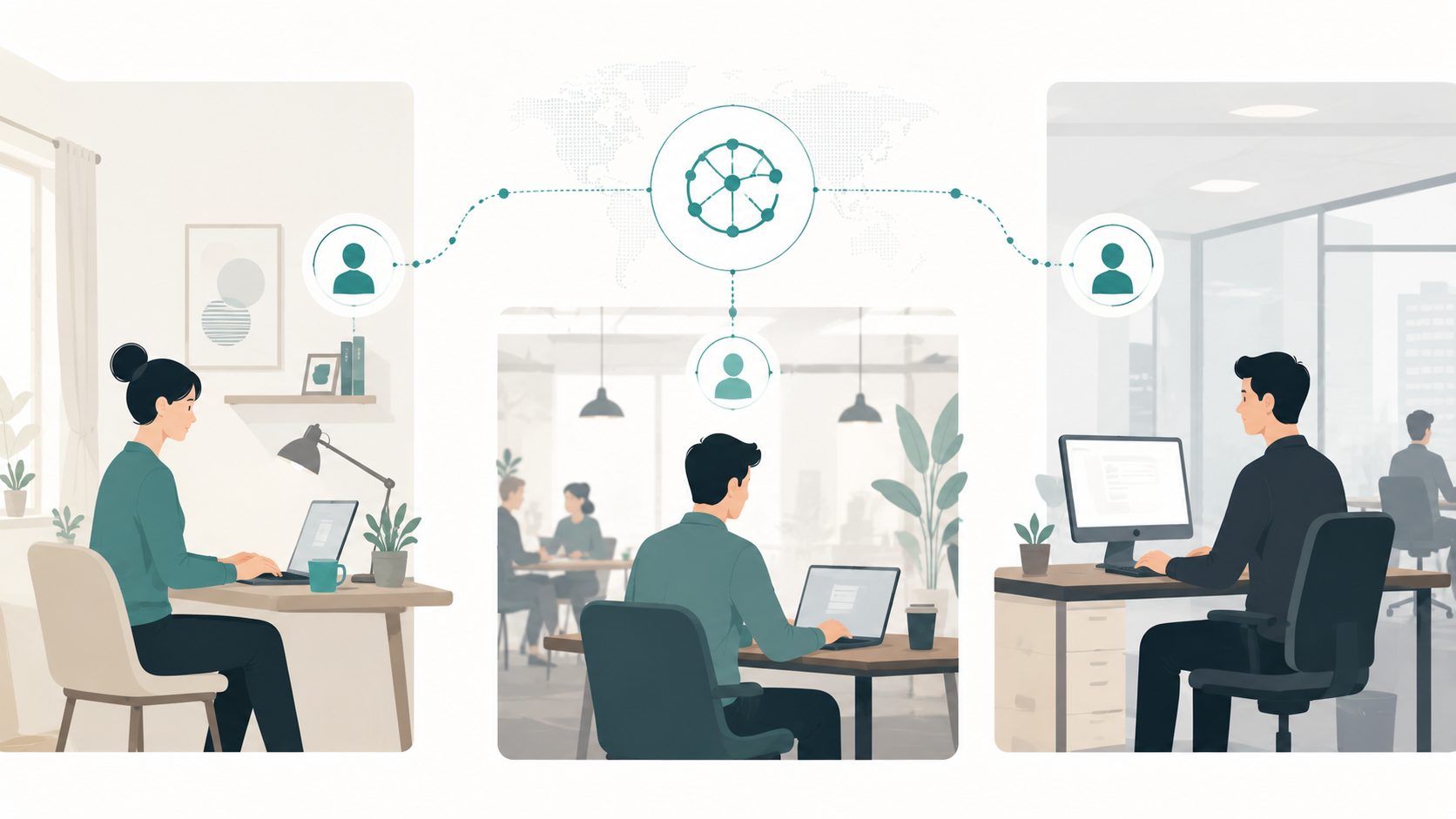
Some of the team works from the office, some from home, others move around as needed. On paper, everyone has equal access to meetings, tools, and information. But performance is far from even — some people are thriving, while others seem increasingly left behind.
Many leaders conclude this is about individual discipline. But often, it’s about something more fundamental: the same leadership style being applied to vastly different working patterns.
Leading a hybrid team isn’t simply about scheduling who works from where. It’s about understanding that every team member has different needs for structure, communication, and support — and one identical leadership approach won’t work equally well for everyone.
When everyone works from the office, many things happen automatically without needing to be deliberately designed. Quick questions get answered by glancing at the next desk. Signs of discomfort can be read through body language. Informal collaboration just happens in the pantry or the elevator.
In hybrid teams, all of this disappears or shrinks dramatically — and what replaces it depends heavily on how deliberately the leader redesigns how their team works.
What makes this more complex: every team member responds to this shift differently. Some people are actually more productive without office distractions. Others lose motivation without the social interaction they used to get. Some need clearer structure to replace the office routine that’s now gone.
In a fully office-based team, a consistent leadership style is relatively easier to apply because the context is uniform — everyone is in the same environment, with the same rhythm.
In hybrid teams, this context becomes highly variable:
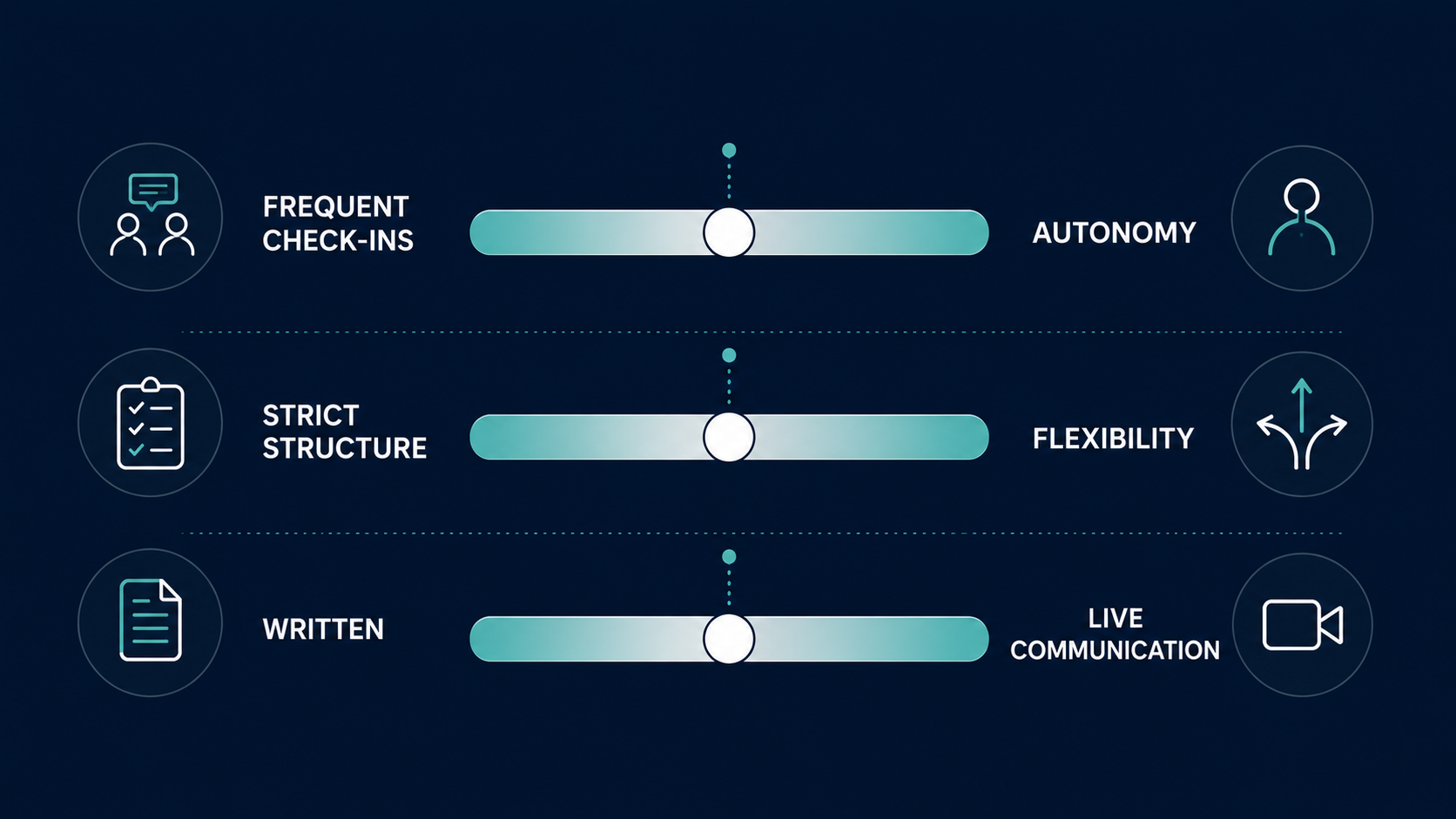
People who need more frequent check-ins vs. those who need more space
Some people feel more secure with more regular communication when working remotely. Others feel micromanaged if asked about progress too often.
People productive with strict structure vs. those productive with flexibility
Without office routine, some people need more explicit work structure to stay focused. Others actually thrive better with the freedom to manage their own time.
People comfortable with written communication vs. those who need live conversation
Communication preference becomes far more critical in a hybrid environment. Misunderstandings that could be clarified informally in an office can drag on in a hybrid setting because they depend on chat or email.
Applying the same approach to everyone in this situation risks making some people feel neglected, and others feel overly monitored.
A few signals commonly appear when a leadership approach hasn’t been adjusted to hybrid team realities:
Understand each individual’s structural needs, don’t assume they’re all the same
Some people need clear, scheduled daily check-ins. Others are actually more productive with greater autonomy. Understanding this difference helps design a working rhythm suited to each person, rather than one system forced on everyone.
Adjust how you give feedback to individual communication preferences
Some people are more comfortable receiving feedback in writing, giving them time to process. Others actually need live conversation to truly understand the context.
Deliberately rebuild the connection moments that have been lost
Informal interactions that used to happen naturally in the office need to be deliberately redesigned in a hybrid environment — tailored to each team member’s social preferences, rather than forced into one identical format for everyone.
Cavlent helps leaders understand each team member’s working patterns, communication preferences, and structural needs objectively — information that becomes far more critical when a team is no longer in the same physical space.
With this data, leaders don’t have to guess which approach works best for each person. They can design ways of working, communicating, and supporting that genuinely fit how each individual in the hybrid team performs best.
→ Explore Cavlent’s solutions for team synchronization
→ Case study: team mapping summary for a holistic view of collective team patterns
→ What made you successful might be slowing you down now
→ Your team looks busy — so why aren’t the results showing?

Why isn’t one leadership style enough for hybrid teams?
Because in a hybrid environment, the need for structure, communication preferences, and how individuals stay motivated become far more varied compared to when everyone works from the same office. A uniform approach risks fitting some people while making others feel neglected or overly monitored.
What are the signs that a leadership style doesn’t fit a hybrid team?
Common signs include: individual performance varying dramatically without a clear pattern, team members feeling isolated despite being connected through communication tools, increasing miscommunication because communication assumptions are never clarified, and previously strong performers suddenly struggling without a clear explanation.
How do you understand each hybrid team member’s structural needs?
Pay attention to how they respond to different levels of oversight — whether they’re more productive with clear, scheduled check-ins, or with greater autonomy instead. Objectively mapping behavioral patterns helps understand this without relying on time-consuming trial and error.
What’s the most critical difference between leading an office team and a hybrid team?
In an office, many things happen automatically — quick clarification, nonverbal cues, informal interaction. In a hybrid team, all of this disappears unless deliberately designed by the leader. This makes understanding individual preferences far more important than when working in the same office environment.
How does behavioral mapping help hybrid team leaders?
Behavioral mapping helps map each individual’s working patterns, communication preferences, and structural needs objectively. With this data, leaders can design an approach suited to each person on the team — rather than applying one identical system to everyone, which risks being suboptimal for most team members.