

Everyone on this team looks busy. Calendars are packed, the work chat never goes quiet, working late has become routine. But ask about this month’s results, and the answer is disappointing.
If this pattern feels familiar, the problem probably isn’t a lack of hard work. The problem is how that hard work is being distributed.
Team burnout isn’t just about too much workload. More often, it’s about unbalanced role distribution — where a few people carry a load far heavier than it appears, while others aren’t being used according to their actual potential.
Busyness is easy to measure visually — who’s in the most meetings, who replies to chats after hours, who takes the fewest breaks. But this kind of busyness often masks a deeper problem.
A team can look extremely busy for reasons that aren’t actually healthy:
All of these patterns create real busyness — but they don’t always create results equal to the energy spent.
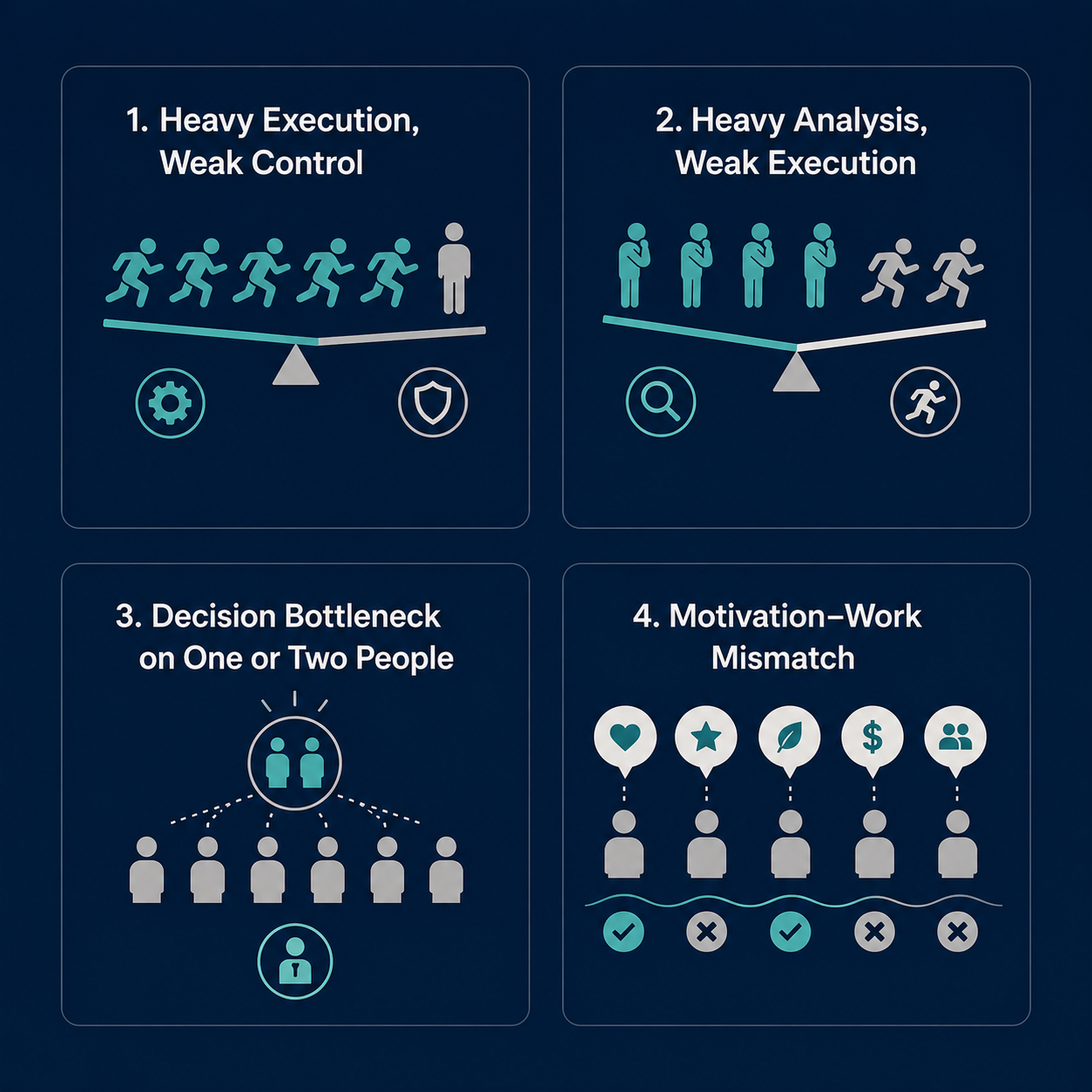
Imbalance within a team usually isn’t visible from the org chart. It shows up in day-to-day working patterns:
Heavy on execution, weak on control
The team moves fast and looks productive — but without enough people ensuring quality and consistency. The result: fast work that often needs to be redone.
Heavy on analysis, weak on execution
The team spends a lot of time planning and discussing — but actual implementation moves slowly because not enough people are focused on getting things done.
One or two people becoming the anchor for every decision
The team looks solid from the outside, but is actually quite fragile — because nearly every important decision depends on the same one or two individuals.
Team motivation misaligned with the dominant type of work
A team with high social motivation is placed in highly individual, repetitive work — or vice versa. The result: energy drains not because the work is heavy, but because it doesn’t align with what actually drives them.
Burnout usually doesn’t happen because of one big event. It builds up from small accumulations that repeat over time.
Someone keeps doing work outside their role because “it’s faster if I just do it myself.” Over time, this load becomes an unquestioned standard — until that person runs out of energy or decides to quit.
What makes this hard to catch early: from the outside, everything looks fine. Targets are still met, deadlines are still hit. But underneath, a few people are carrying a load far from proportional — and this usually isn’t visible until the impact has already become significant.
Notice who’s always the “shortcut”
If there’s one or two people who get contacted for everything — even things that shouldn’t be their responsibility — that’s a signal of imbalance that’s been running for a while.
Look at the pattern of revisions and rework
If mid-course revisions feel like a routine habit rather than an exception, there’s likely a gap between execution speed and the team’s actual control capacity.
Map the team’s collective motivation distribution
Teams with poorly understood motivation distribution tend to misallocate types of work — not intentionally, but because there’s no data to guide that decision.
Cavlent helps organizations understand a team’s role distribution, motivation, and collective capacity — not just evaluating individuals one by one, but seeing how these patterns interact in day-to-day work.
With this data, team leaders can identify where disproportionate load is happening — before it impacts performance or causes key people to decide to leave.
→ Explore Cavlent’s solutions for team synchronization and development
→ Case study: team mapping summary for a holistic view of collective team patterns
→ The importance of healthy conflict for generating the best ideas
→ If every problem is always the team’s fault, maybe the problem isn’t the team
Why isn’t a busy-looking team always a productive one?
Because busyness often stems from unhealthy working patterns — like repeated rework caused by unclear expectations, or one or two people becoming the anchor for every decision. This kind of busyness drains energy without producing proportional output.
What does unbalanced role distribution actually mean?
It’s when workload, responsibility, or important decisions become concentrated in a small portion of the team — while other members aren’t being used according to their potential or motivation. This imbalance usually isn’t visible in the org chart, but is deeply felt in daily working patterns.
What’s the connection between burnout and misaligned work motivation?
When the dominant type of work doesn’t match what naturally motivates someone, energy drains faster — even if the workload isn’t technically excessive. For example, someone with high social motivation placed in highly individual work may experience fatigue even with a relatively light workload.
How can you detect team imbalance before it becomes a crisis?
Watch for recurring patterns: who’s always the go-to person for everything, how often work needs mid-course revision, and whether one or two people are the anchor for nearly every important decision. These patterns typically emerge long before their impact shows up in performance.
How does behavioral mapping help address burnout within a team?
Behavioral mapping helps map a team’s collective motivation, capacity, and working patterns — providing an objective picture of where disproportionate load is occurring. With this data, team leaders can make more accurate workload redistribution decisions, rather than relying on assumptions or surface impressions.