
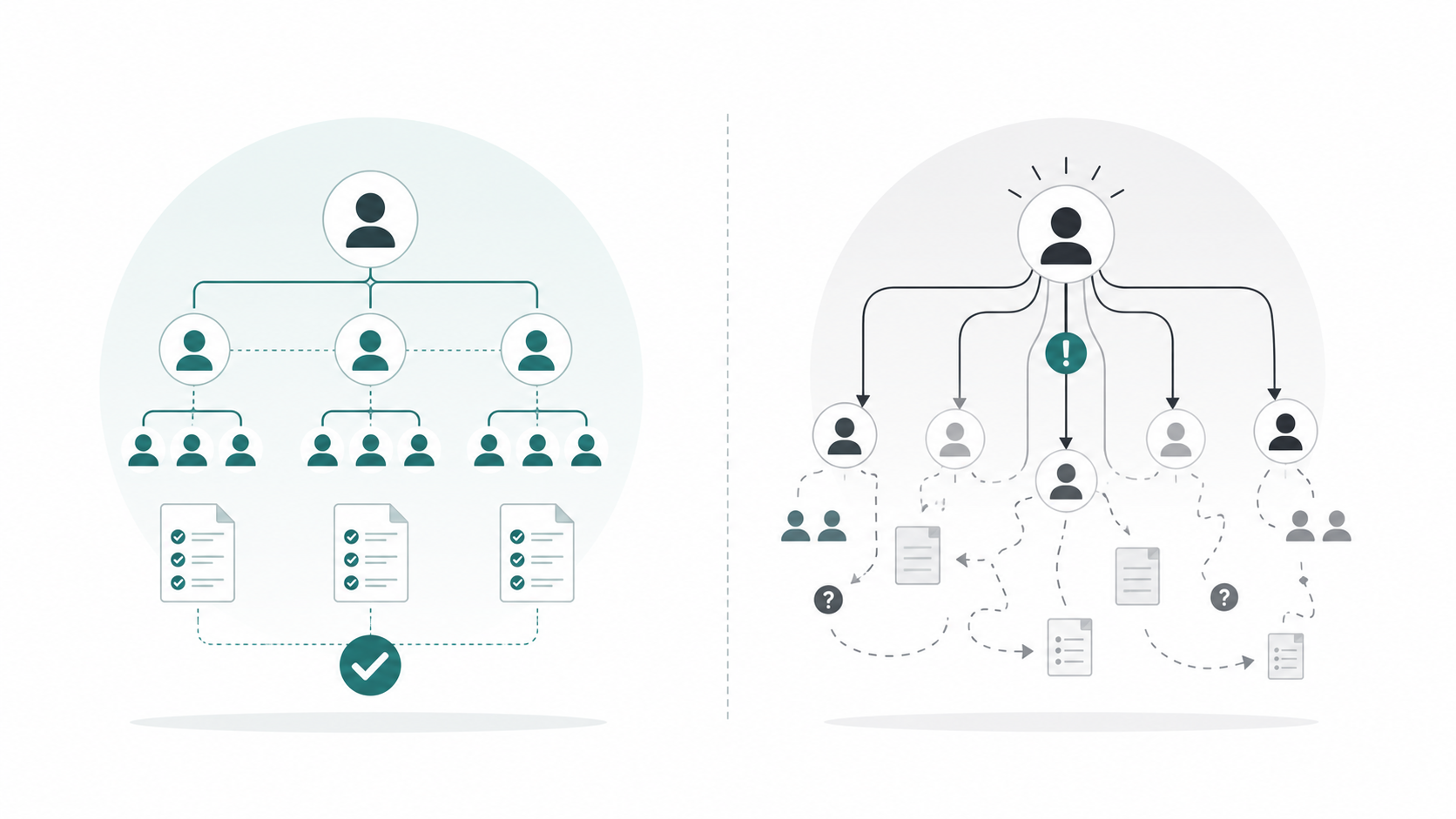
Organizational scaling is the process of significantly expanding a business’s capacity — more customers, more markets, more team — without losing the quality, speed, or culture already built.
Many businesses fail at this stage not because of a product or market problem, but because of one thing rarely checked: are the people inside the organization ready to move at the new speed and complexity?
Signs an organization is ready to scale:
Decisions don’t depend on one person. More than one person can make important decisions without waiting for the founder or top leader. Work processes are documented and can be run by new people without losing quality. The core team has the capacity to manage ambiguity — because scaling always brings uncertainty that can’t be fully planned for. Cross-team communication is running without too much upward escalation.
Signs an organization isn’t ready yet:
Almost every important decision still goes through the same one person. Work processes live in people’s heads, not in systems. The core team is already overwhelmed with current work volume — before expansion has even begun. There are clear leadership gaps at the middle management level that haven’t been filled.
Scaling forced before these conditions are met typically creates more chaos than the growth it produces.
Cavlent helps organizations map the internal readiness of their teams and leadership before scaling decisions are made — identifying gaps that need to be addressed first so that the growth that follows can actually be managed well.
→ Explore Cavlent’s solutions for organizational transformation readiness
→ When the rupiah weakens — why internal organizational readiness determines business resilience
→ Case study: key persons mapping to identify critical individuals before expansion
→ When the data is already there, but change still doesn’t happen
What does organizational scaling mean?
Organizational scaling is the process of significantly expanding a business’s capacity — more customers, markets, or team — without losing the quality, speed, or culture already built. It’s different from slower, more gradual organic growth.
Why do many businesses fail in the scaling phase despite having a proven product?
Because scaling isn’t just about duplicating what’s already working — it’s about ensuring the systems, processes, and people inside the organization are ready to move at significantly higher speed and complexity. This internal readiness is often not checked until problems have already surfaced.
What’s the first step before deciding to scale?
Audit internal readiness: are important decisions still dependent on one person, are work processes documented, does the core team have capacity headroom to manage increased volume, and are there leadership gaps at the middle management level that haven’t been filled yet.