
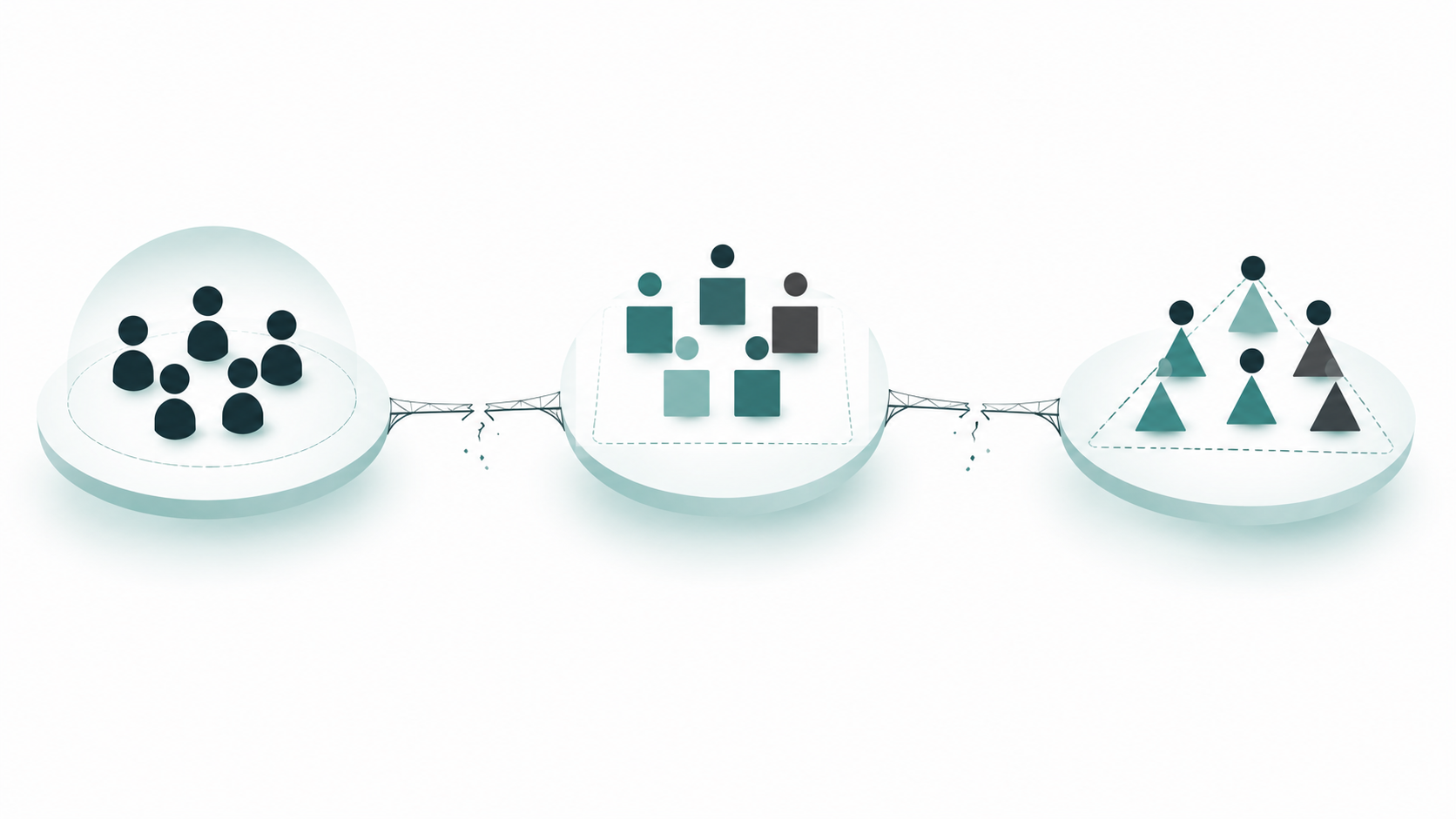
Organizational silos occur when departments operate separately with their own priorities, rhythms, and working language — making cross-team collaboration feel heavy even when everyone shares the same goal.
Sales thinks marketing is too slow. Marketing thinks sales is impatient. Product thinks both don’t understand technical constraints. Everyone is right from their own vantage point — and that’s exactly where the problem begins.
What often gets mistaken for an organizational structure problem is actually more often about differences in working patterns that have never been genuinely understood across teams. Sales teams typically move fast and prioritize short-term results. Product teams typically prioritize precision and long-term outcomes. Neither is wrong — both are valid, just operating on different rhythms.
Restructuring rarely solves this, because the root cause isn’t the reporting line — it’s how each team naturally thinks and works.
The most effective fix is understanding each team’s dominant working pattern explicitly, then designing communication touchpoints that respect those rhythm differences — rather than forcing one identical way of working onto everyone.
Cavlent helps organizations map collective working patterns across teams — providing a more objective foundation for designing cross-department collaboration that actually works, not just on paper.
→ Explore Cavlent’s solutions for team synchronization
→ How to see your organization more completely: forest and tree at the same time
→ Your team looks busy — so why aren’t the results showing?
→ If every problem is always the team’s fault, maybe the problem isn’t the team
What are organizational silos?
Organizational silos occur when departments operate separately with their own priorities, rhythms, and working language — making cross-team collaboration feel heavy even when the end goal is shared.
Why doesn’t restructuring usually fix cross-department collaboration problems?
Because the root cause usually isn’t the organizational reporting line, but differences in each team’s natural working pattern and rhythm that have never been genuinely and explicitly understood by other teams.
How can cross-department collaboration be improved effectively?
Start by explicitly understanding each team’s dominant working pattern, then design communication touchpoints that respect those rhythm differences — rather than forcing one identical way of working across all departments.