

Follow-through is the ability to translate gained understanding into consistently measurable behavioral change — not just momentary enthusiasm right after a training session ends.
This is where most training and coaching investment leaks.
Not because the material wasn’t good. Not because the facilitator lacked skill. But because of a fundamental gap that rarely gets addressed: the difference between a team that can understand insights and a team that can execute them consistently.
Picture a team that just completed an intensive coaching session. Energy is high, enthusiasm feels real, everyone is aligned on the new direction. Then three weeks later, the old routines return. Commitments made during coaching gradually fade. And no one quite knows exactly when the change stopped.
What often goes unnoticed: the problem isn’t the coaching. The problem is the team’s condition before and after coaching.
A team that’s collectively stronger at thinking about direction than ensuring execution will struggle to turn insight into action — not because they don’t want to, but because their collective working patterns aren’t yet strong enough there. This isn’t a failure, it’s a reality that needs to be managed consciously.
1. The team is too strong at strategy, too weak at execution
Many teams are very capable of discussing, analyzing, and planning — but when it comes to ensuring work is completed to a consistent standard, their capacity is significantly weaker. Coaching insights don’t need a team that’s better at thinking. They need a team that’s stronger at finishing what’s already been thought through.
2. Accountability is assumed, not built
After coaching, it’s often assumed everyone will translate agreements with the same level of discipline. They won’t. Without a clear structure — who’s responsible for what, when it gets checked, and what happens when it doesn’t run — commitment relies entirely on momentary enthusiasm.
3. No baseline of team conditions before intervention
When there’s no objective picture of the team’s soft skill condition before training begins, it’s difficult to design targeted follow-through. Everyone gets the same intervention — even though each person’s capacity and needs differ significantly.
The biggest risk isn’t a team that doesn’t understand what was taught. The biggest risk is a team that understands a great deal but doesn’t have a structure strong enough to turn that understanding into habits that stick.
A simple framework that helps: Priority → PIC → Target → Checkpoint → Accountability.
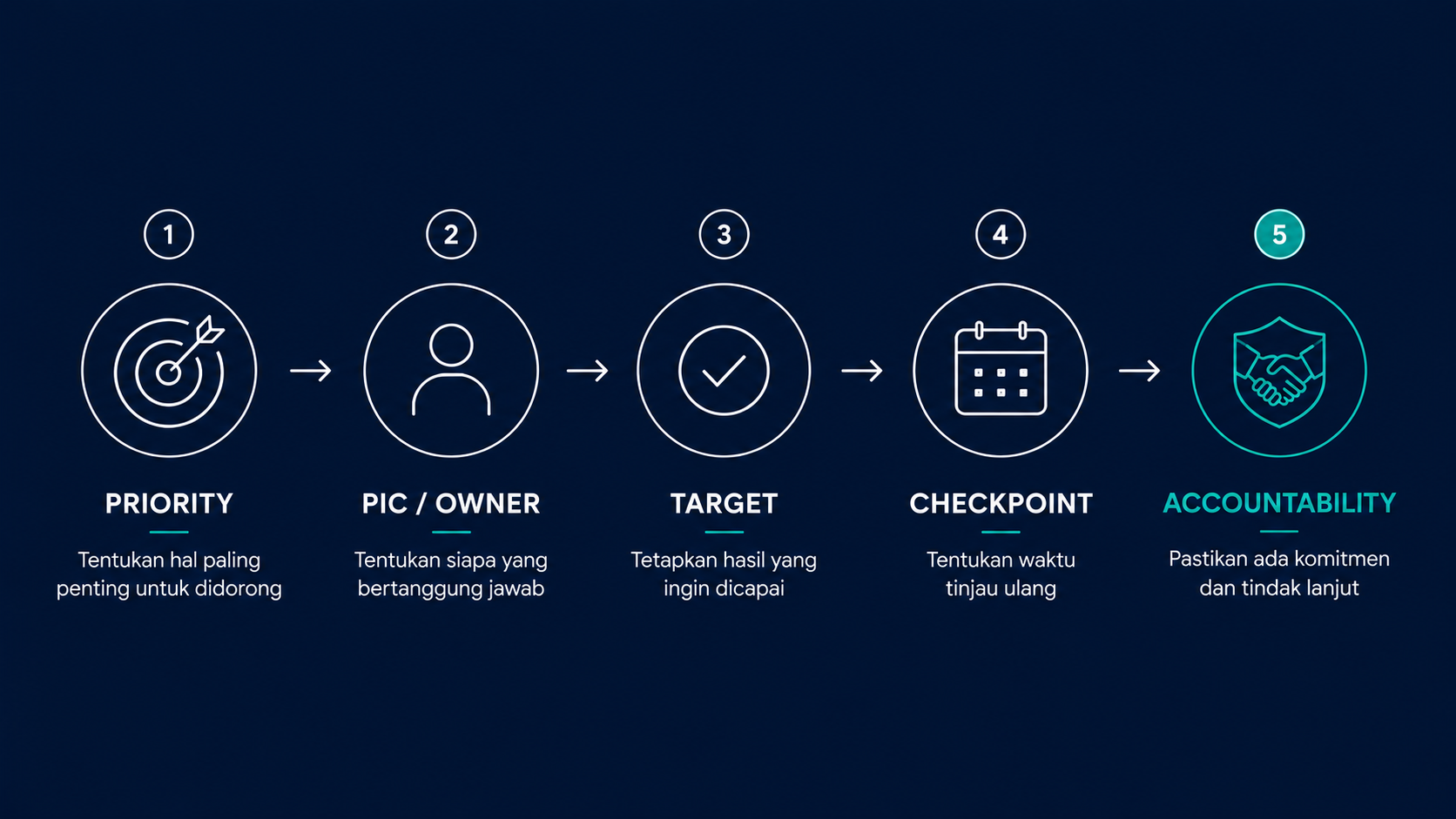
Choose a small number of changes that genuinely need to be maintained. Ensure every commitment has a clear owner. Define output and deadlines. Schedule regular progress reviews. And don’t rely on post-session enthusiasm to sustain momentum.
Understanding the collective soft skill patterns of a team before and after an intervention helps organizations design follow-through that’s more accurately targeted. Not one approach for everyone, but a structure adapted to the actual condition of the team being managed.
Cavlent’s Exercise Card can be a useful tool in this process — helping teams start more structured conversations about commitment, accountability, and the changes they want to sustain after a coaching or training session ends.
Cavlent also helps organizations understand their team’s collective soft skill condition objectively — providing a clearer picture of where follow-through capacity needs strengthening before any development program is designed.
→ Explore Cavlent’s solutions for people development that creates real impact
→ What is training needs analysis — and how behavioral data makes it more accurate
→ Your team looks busy — so why aren’t the results showing?
→ Cavlent Exercise Card: a tool for more honest and structured conversations in your team
Why don’t insights from coaching or training stick long-term?
Not because the training quality was poor — but because there’s a gap between understanding an insight and executing it consistently. A team stronger at strategic thinking than execution follow-through will struggle to turn new understanding into lasting behavioral change without a clear, measurable follow-through structure.
What does follow-through mean in the context of training and coaching?
Follow-through is the ability to translate gained understanding into consistent behavioral change — not just momentary enthusiasm after a session ends. It includes clarity about who’s responsible for what, when it gets checked, and how deviations are managed when normal routines return.
How do you ensure a training or coaching program actually creates impact?
Start by understanding the team’s actual condition before the intervention is designed — including collective soft skill patterns that determine follow-through capacity. Then build clear accountability structures after the session: focused priorities, clear ownership, measurable targets, and regular checkpoints.