
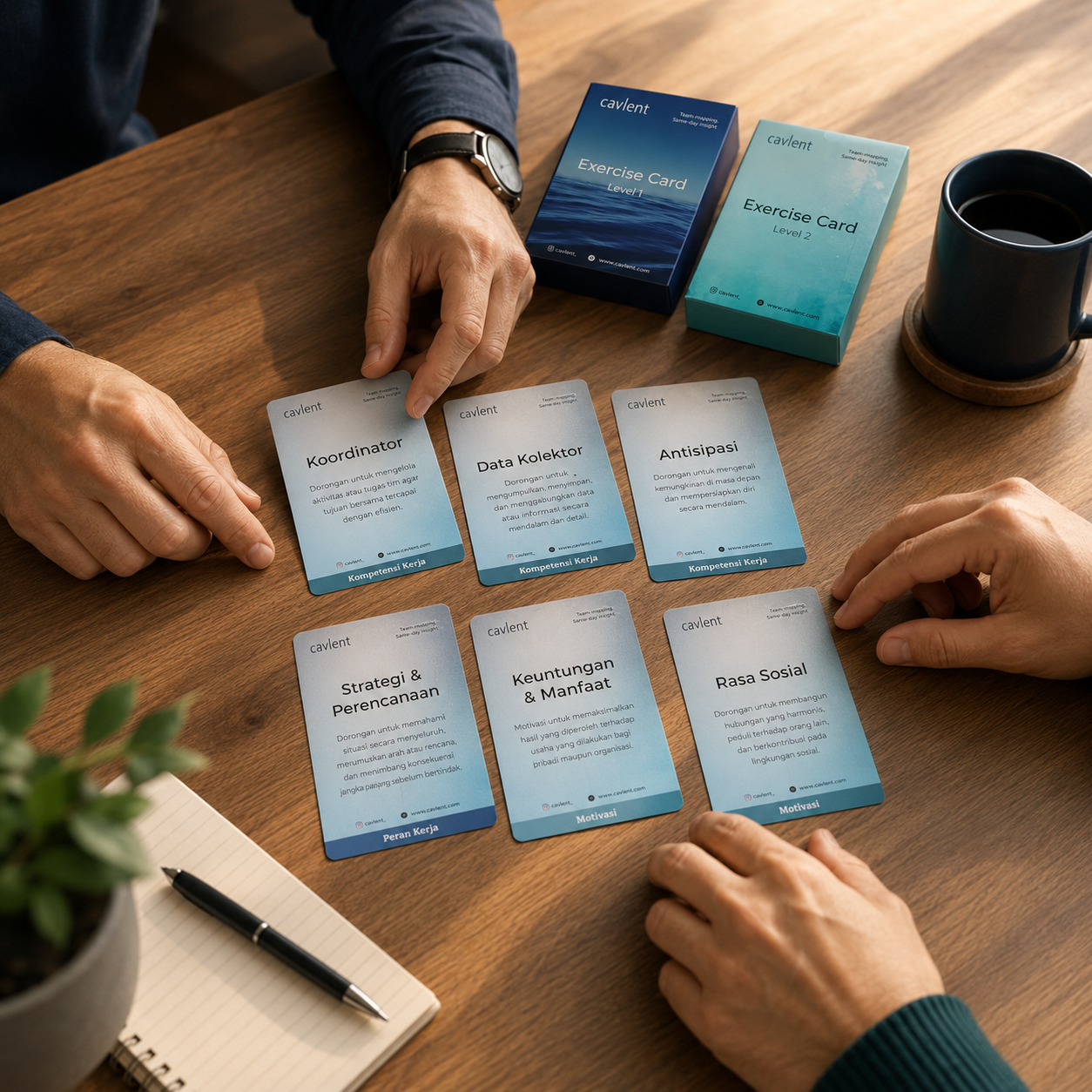
Exercise Card is a practical, A7-sized training card set (about the size of a playing card) created by Cavlent to support individual reflection, team discussions, coaching, hiring, and soft skill development. The cards contain vocabulary for work competencies, work roles, and work motivation, helping someone describe their own or others’ work attitudes more concretely and objectively.
Regular personality tests usually produce results in the form of a fixed label. Cavlent’s Exercise Card isn’t a testing tool — it’s a conversation tool used interactively in training sessions, coaching, or team discussions, to open up a more concrete discussion about work competencies, either before or after reviewing a Cavlent assessment report.
Level 1 contains 29 cards: 20 Work Potential cards, 4 Work Role cards, and 5 Work Motivation cards. Level 1 focuses on foundational elements such as natural potential, role fit, and a person’s work motivation.
Level 2 contains 60 Work Competency cards, covering concrete and specific abilities that show up in interactions, decision-making, and everyday task execution in the workplace.
Not necessarily, but it’s recommended. Level 1 and Level 2 can be purchased separately based on your needs. However, the complete set (89 cards, combining Level 1 and Level 2) gives the most comprehensive picture, since it covers basic potential, roles, and motivation, as well as more detailed work competencies.
Exercise Card is A7-sized, the same as a standard playing card, making it easy to bring into any training room, meeting, or coaching session.
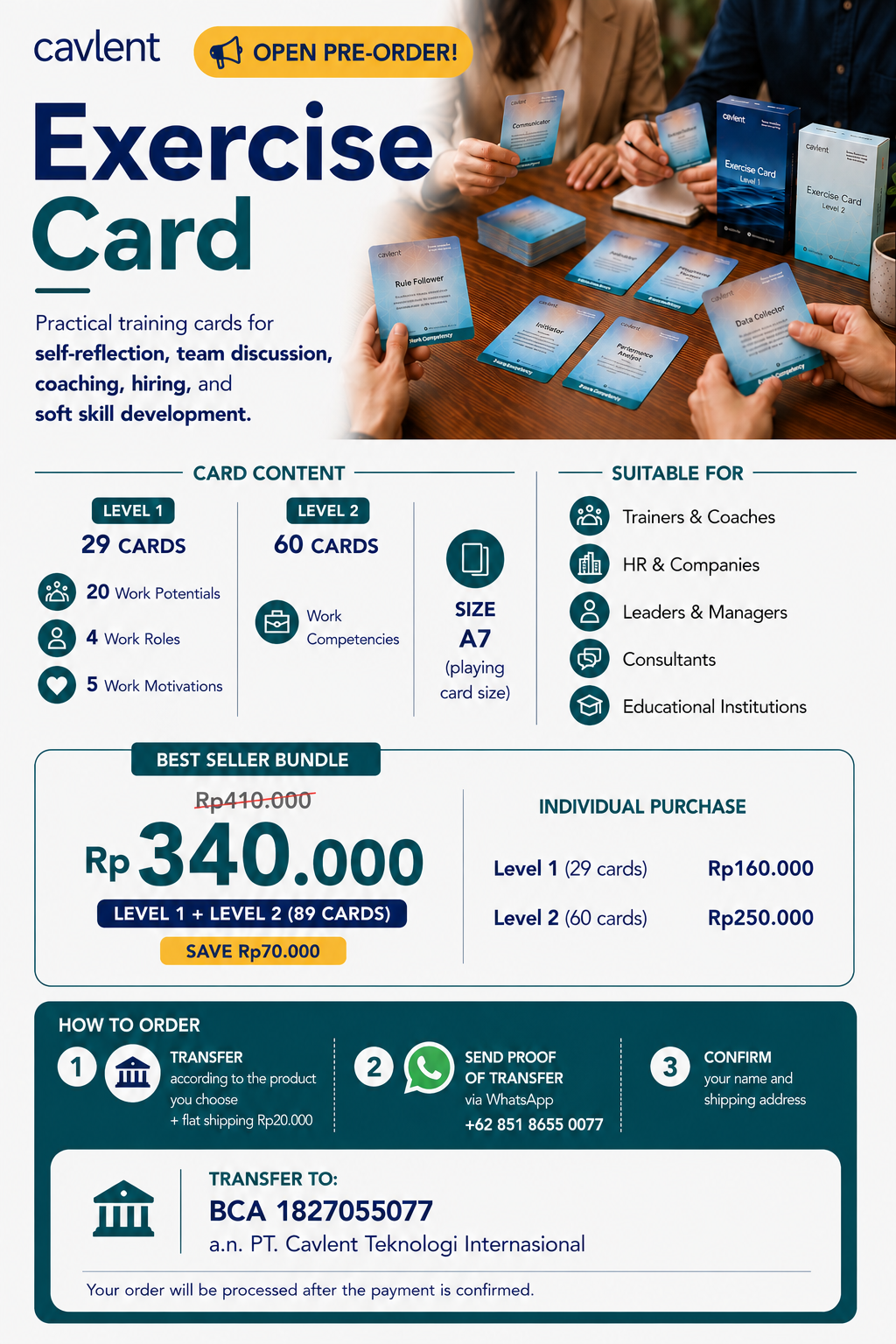
Ordering is done in three steps:
For bulk order needs, such as for HR teams, training institutions, or educational institutions, please contact the Cavlent team directly via WhatsApp at +62 851 8655 0077 for special offer information.
How is Exercise Card used in a training session?
In a group training session, participants are given cards to analyze a work situation — for example, a colleague’s behavioral profile or expectations for a particular role. The cards become dynamic case studies that can be adapted to various contexts, before the discussion moves on to reviewing the Cavlent assessment report.
How is Exercise Card used for hiring or promotion?
HR teams use the cards to define the soft competency requirements for each position more objectively. With clear competency vocabulary, HR can distinguish between traits that are genuinely needed, traits that are just “decoration,” and traits that could be potential blind spots when reviewing a candidate’s or employee’s report ahead of a promotion decision.
How is Exercise Card used for individual coaching?
The coachee is asked to observe, on their own, what their strengths, bottlenecks, and weaknesses are based on personal observation, using the cards, before their own Cavlent assessment report is opened. After the report is reviewed, this self-observation is compared against the objective data to see whether the coachee’s self-understanding has tended to be accurate or biased.
Can Exercise Card be used alone, without a facilitator or coach?
Exercise Card is designed to be used with facilitation — whether by a trainer, coach, HR professional, manager, or consultant/psychologist — since its main value comes from shared discussion and exploration. Individual practice without a facilitator is still possible for personal reflection, but the benefits are greatest when discussed together with others.
Is Exercise Card used before or after the assessment?
More precisely, it’s about before or after the report is opened, since a Cavlent assessment can be done at any time.
What happens if a participant’s perception during the card exercise doesn’t match the assessment report?
This mismatch is actually an important part of the learning process. The gap between perception (whether self-perception or perception of others) and the objective data in the report helps participants recognize areas of bias they may not have been aware of before, and becomes material for deeper discussion with a facilitator or coach.
Can Exercise Card be used repeatedly with the same team?
Yes. Because the cards function as dynamic case studies, the same cards can be explored from different contexts and work scenarios in each session, so it doesn’t feel repetitive even when used repeatedly with the same team.

Who is a good fit for using Exercise Card?
Exercise Card is suitable for trainers and coaches, HR teams and companies, leaders and managers, consultants and psychologists, as well as educational institutions. Each profession can adapt how they use the cards to their specific needs — from training facilitation and team development to decision-making, learning activities, and mentoring.
Is Exercise Card suitable for educational institutions?
Yes. Educational institutions can use Exercise Card for learning activities, mentoring, and character development for students, using the same approach: building competency vocabulary and contextual understanding of strengths and weaknesses across different situations.
Is Exercise Card suitable for small businesses without a formal HR team?
Yes, it’s a good fit. A leader or business owner handling HR functions themselves can use Exercise Card to build clearer communication with their team, align role expectations, and make better decisions about role placement, even without a formal HR structure in place.

Is Exercise Card the same as the Cavlent assessment?
No, they’re not the same. The Cavlent assessment is an online behavioral mapping test that produces an objective data report about a person. Exercise Card is a physical card set used as a discussion and reflection tool, typically paired with the assessment report to validate or deepen the understanding that emerges from the discussion.
Do I need to have a Cavlent assessment report to use Exercise Card?
Not required upfront, but highly recommended as part of the full process. Exercise Card can still be used for open discussion and reflection without an assessment report, but the maximum benefit comes when the results of the card discussion are validated against data from the Cavlent assessment report.
Can’t find the answer you’re looking for? Contact the Cavlent team via WhatsApp at +62 851 8655 0077.