

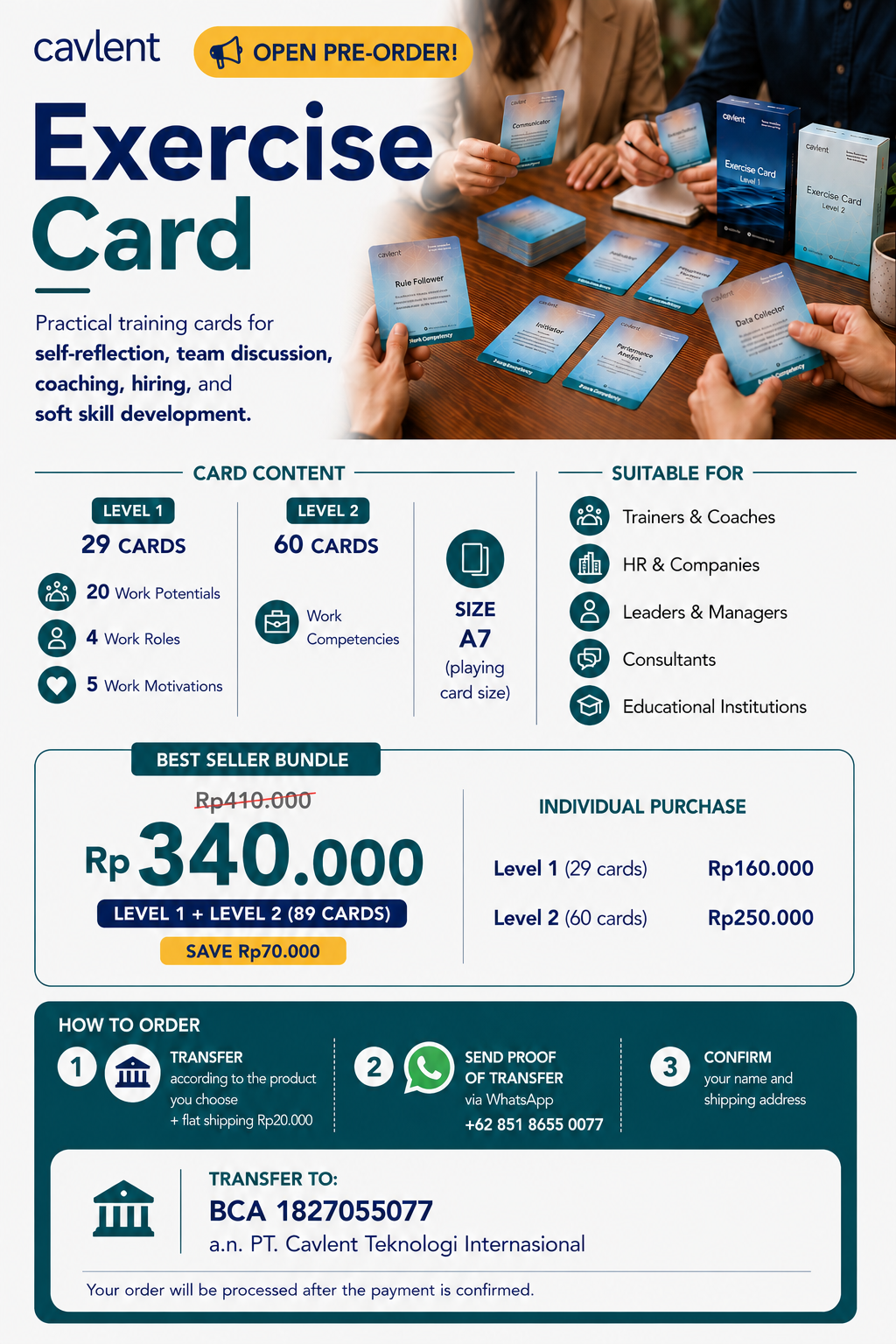
Exercise Card is a physical, A7-sized card set created by Cavlent that contains vocabulary for work competencies, work roles, work motivation, and advanced work competencies. The cards are used as an open-conversation tool in training sessions, team discussions, coaching, and hiring or promotion processes — either as a warm-up before reading a Cavlent assessment report, or as a follow-up tool afterward. Two levels are available: Level 1 (29 cards, focused on potential and work motivation) and Level 2 (60 cards, focused on work competencies), totaling 89 cards if purchased as a full set.
Exercise Card is a practical training tool designed by Cavlent to help individuals and teams talk about something that’s usually hard to put into words directly: how someone actually behaves, reacts, and makes decisions at work.
Unlike conventional personality tests that immediately slap on a label (“you’re an introvert,” “you’re a leader type”), Exercise Card works as an open-conversation tool. The cards provide concrete vocabulary to describe a person’s competencies, roles, and work motivation — turning what’s usually an abstract discussion (“they lack initiative,” “they’re hard to manage”) into something more specific and actionable.
The cards are A7-sized, about the size of a playing card, making them easy to bring into any meeting room, training session, or coaching space.
Exercise Card was born from a common workplace need: people struggle to articulate exactly what they mean when assessing someone’s work attitude — whether their own or a colleague’s. Without the right vocabulary, work evaluations end up biased, overly generic, or even offensive without offering any useful insight.
Three main goals of the Exercise Card:
Exercise Card is available in two levels, which can be purchased separately or as a complete set.

Level 1 — 29 Cards (Foundation)
• 20 Work Potential cards
• 4 Work Role cards
• 5 Work Motivation cards
Level 1 focuses on foundational elements: a person’s natural potential, which roles suit them, and what truly motivates how they work.
Level 2 — 60 Cards (Work Competencies)
• 60 Work Competency cards
Level 2 goes deeper into more specific and applicable work competencies — concrete abilities that show up in interactions, decision-making, and everyday task execution.
Complete Set — 89 Cards
Combining Level 1 and Level 2 gives the most comprehensive picture: from basic potential, roles, and motivation, to more detailed work competencies. This combination is most recommended for ongoing team development needs, rather than a one-time use.

Exercise Card is designed to be flexible for various roles involved in people development at work:
The way Exercise Card works is simple yet impactful: participants are given one or more cards to analyze a work situation — whether it’s their own situation, a colleague’s, or a candidate being evaluated.
Because the cards offer clearly defined vocabulary (such as “Anticipation,” “Coordinator,” “Rule Enforcer,” “Data Collector”), participants don’t have to guess at the right words to describe what they’re observing. This often opens up conversations that hadn’t happened before — including stories or observations that had never been openly shared.
This discussion is typically followed by a review of the Cavlent assessment report, to validate how accurate the understanding or perception that emerged during the card exercise actually is, compared to the real behavioral data.
1. Group Training & Coaching
The cards become dynamic case studies that can be adapted to various work contexts. Participants are trained to view situations from an HR perspective on behavior — for example, analyzing a colleague’s situation or expectations for a particular role — before the discussion moves on to the assessment report.
2. Hiring & Promotion
HR teams are trained to define the soft competency requirements for each position more objectively, since they now share a consistent vocabulary. When reviewing a candidate’s report, the hiring team finds it easier to distinguish which traits are genuinely needed, which are just CV “decoration,” and which could be potential blind spots.
3. Individual Coaching
Coachees are trained to observe for themselves what their strengths, bottlenecks, and weaknesses are — before their own Cavlent report is opened. This order matters: card exercise first, then the report, to see how objective — or how biased — a person’s self-understanding really is.
For a deeper dive into each of these applications, read the related articles:
This is the most commonly asked question, and the answer is: it can be both, depending on the goal. More precisely, the real question isn’t “before or after the assessment” (since a Cavlent assessment can be done at any time), but rather before or after the report is opened.

Every application of Exercise Card comes back to one foundational principle: people can’t be seen in black and white. A person’s behavior is highly context-dependent. A strength applied in the wrong situation can turn into a liability, while a weakness that emerges in the right situation can actually be an advantage.
This principle is what sets Exercise Card apart from being just a “personality quiz card” — it trains contextual thinking about human behavior at work, rather than handing out permanent labels.
How to Order