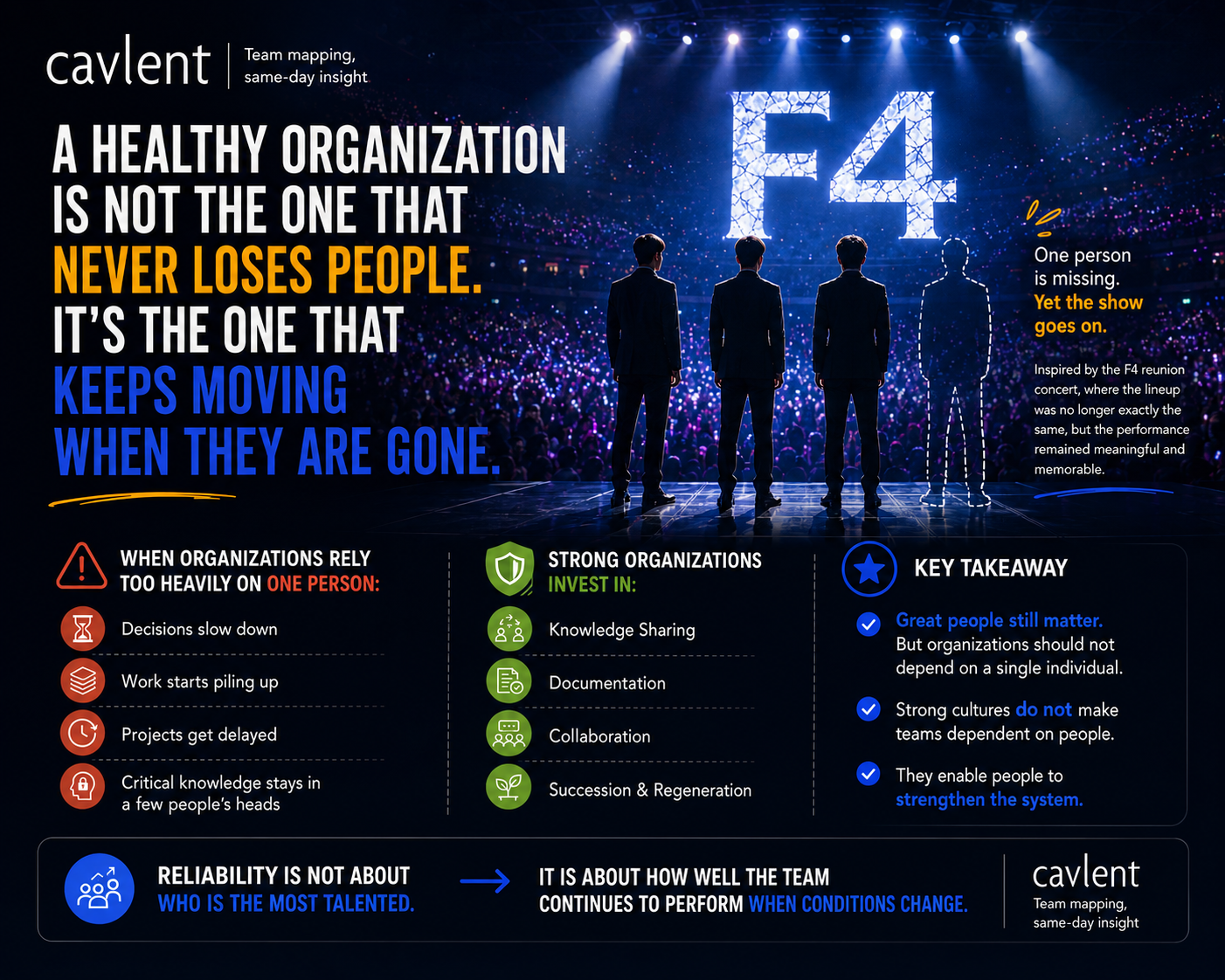
At the end of May 2026, the F4 reunion concert in Indonesia became one of the most talked-about events. Although the lineup was not exactly the same as the original group, the concert still went on and remained memorable.
There is an interesting lesson here for organizations. A healthy organization is not one that never loses people. It is one that can continue operating when one of its key people is no longer there.
People will always come and go. Some resign, some get promoted, some retire, and some move into different roles. The real question is not, “Do we have great people?” The real question is, “Can the organization continue to perform when those people are no longer there?”
Because reliability is not about never losing people. Reliability is the ability to continue functioning when conditions change. Organizations that become overly dependent on a single individual often begin to show symptoms such as:
In contrast, organizations that are better prepared usually invest in:
Great people will always matter. But organizations should never depend on a single person. Strong organizational cultures do not make teams dependent on individuals. Instead, they enable individuals to strengthen the system.
Frequently Asked Questions
What is the main lesson organizations can take from the F4 reunion concert?
That a healthy organization isn’t one that never loses people — it’s one that can keep moving when an important person isn’t there. Just as F4 delivered a memorable concert despite not having their exact original lineup, a strong organization has systems, culture, and regeneration mechanisms that allow them to keep going despite personnel changes.
What is “organizational reliability” and why does it matter?
Organizational reliability is the ability of an organization to function consistently despite change — personnel turnover, role shifts, or external pressure. A reliable organization doesn’t depend on one individual to run. Knowledge is documented, processes are clear, and regeneration happens naturally rather than reactively.
What are the signs that an organization is overly dependent on one individual?
Common signs include: decisions stalling when that person is unavailable, work piling up in one person’s hands, projects delayed because no one else can step in, and critical knowledge living only in one person’s head rather than in a system. This is a hidden risk that often goes unnoticed until that person actually leaves.
How do you build an organization that isn’t overly dependent on one person?
Start with three things: active knowledge sharing (documenting important processes and decisions), structured collaboration (ensuring more than one person understands critical functions), and intentional regeneration (identifying and developing candidates who can take over key roles). Behavioral mapping helps identify who needs to be developed and for which roles.
What is the connection between organizational reliability and behavioral team mapping?
Behavioral team mapping helps organizations see the distribution of roles, motivations, and team member potential objectively — including identifying who is a “single point of failure” in the system. With this information, organizations can begin building redundancy and regeneration more intentionally, rather than reactively.