

Someone who's always quiet in meetings gets labeled disengaged or not caring. Someone who agrees quickly is assumed to be the most cooperative. Someone who talks a lot is assumed to be the most engaged.
But when the data is examined more closely, these assumptions are often wrong — and misreading work patterns has real consequences.
Behavior visible on the surface is data. But data needs context before it can be interpreted accurately.
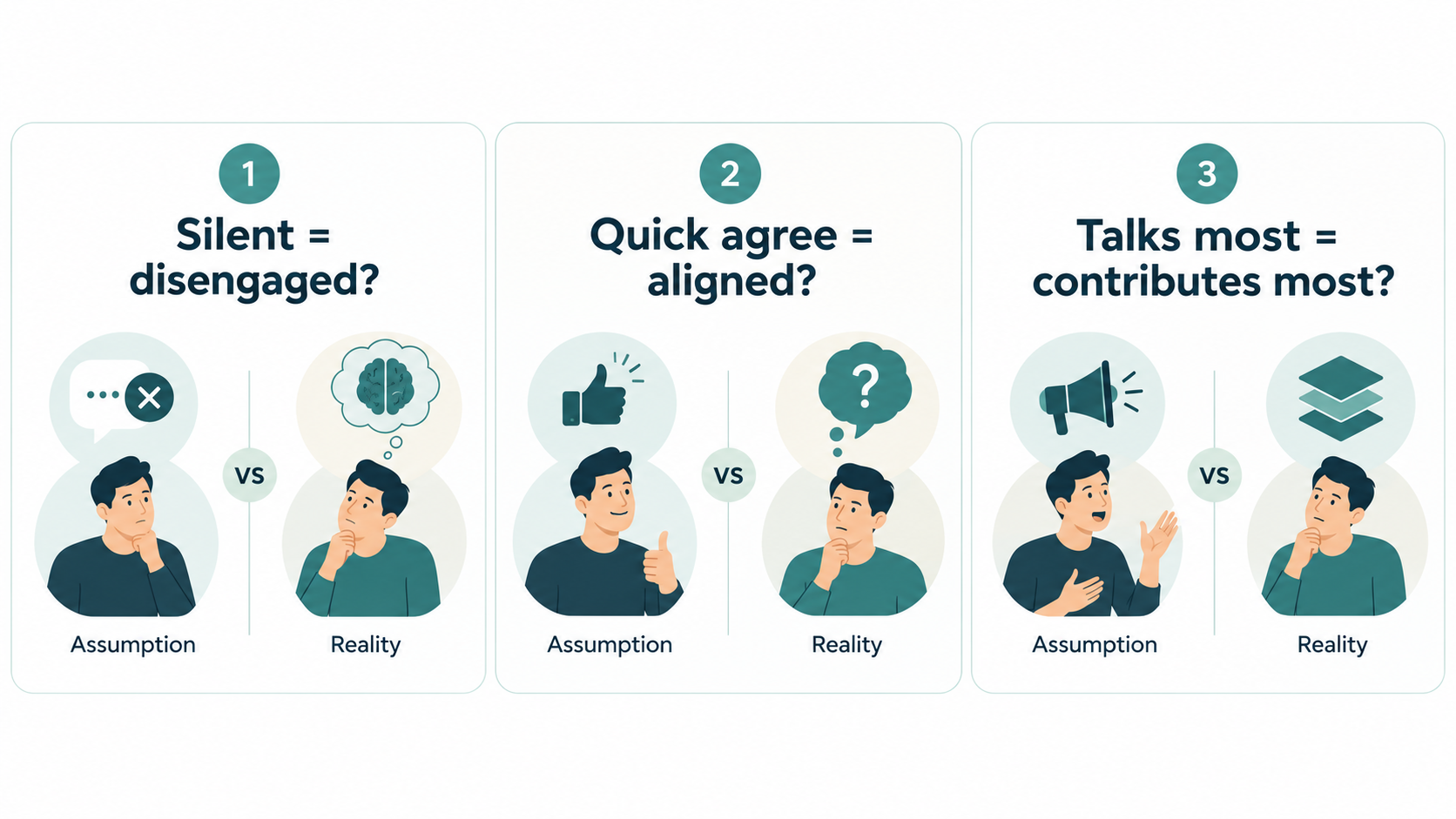
Silent in meetings ≠ disengaged or incompetent
Someone who stays quiet in meetings can mean many very different things. They may be highly analytical — needing time to process before speaking, and uncomfortable with unrefined opinions. They may be uncomfortable with the existing group dynamics — not because they have no view, but because they don't feel safe expressing it. Or they may have a dominant executor role, not a strategic thinker role — and conceptual meetings simply aren't the context where they contribute most.
Judging someone as "not engaged" purely from their silence in meetings is one of the fastest ways to lose your best contributors who aren't verbally expressive.
Quick agreement ≠ genuine agreement
Someone who always nods and says "yes" in meetings doesn't necessarily agree. In work cultures that prioritize harmony — like many Indonesian teams — quick agreement can actually signal that someone doesn't feel safe to disagree. This is a low psychological safety signal, not genuine alignment.
And decisions built on this "false agreement" often meet quiet resistance during execution — because people who didn't actually agree remain disagreeing, their expression simply shifts from the meeting room to the field.
Talking a lot ≠ contributing most
In many team discussions, the person who talks most gets a disproportionate share of attention — including in contribution evaluations. But volume of speech and quality of contribution are two very different things. The person who speaks least may be the deepest thinker — their way of contributing just isn't through verbal dominance.
When assumptions about someone's working patterns aren't accurate, decisions built on them — who gets promoted, who's considered high-potential, who "doesn't fit" — are also inaccurate.
What's needed isn't better intuitive people-reading ability. What's needed is more objective data about someone's actual behavioral patterns — so a single surface behavior isn't immediately translated into a conclusion that may be wrong.
Cavlent helps organizations understand individual behavioral patterns more objectively — providing context that helps distinguish what's visible on the surface from what's actually happening beneath it.
→ Learn about Cavlent's behavioral mapping approach
→ Why intuition alone isn't enough for people decisions
→ What is psychological safety and why every team needs to build it
Why can the same work pattern mean different things for different people?
Because behavior visible on the surface always needs context to be interpreted accurately. Someone quiet in meetings could be highly analytical, not feeling safe to speak, or simply not contributing through verbal discussion — three very different conditions that look the same from the outside. Without more objective data, the interpretation made is vulnerable to observer bias.
What are the consequences of misreading a team member's work patterns?
People decisions built on inaccurate assumptions — who gets promoted, who's considered high-potential, who "doesn't fit" — are also inaccurate. This directly impacts talent retention, the quality of teams formed, and the effectiveness of development interventions designed.
How do you read someone's work patterns more accurately?
By adding a more objective data layer alongside day-to-day observation. Observation provides a picture of what's visible — behavioral data provides context about why someone tends to behave that way, and what genuinely drives them. The combination produces understanding far more accurate than either alone.