
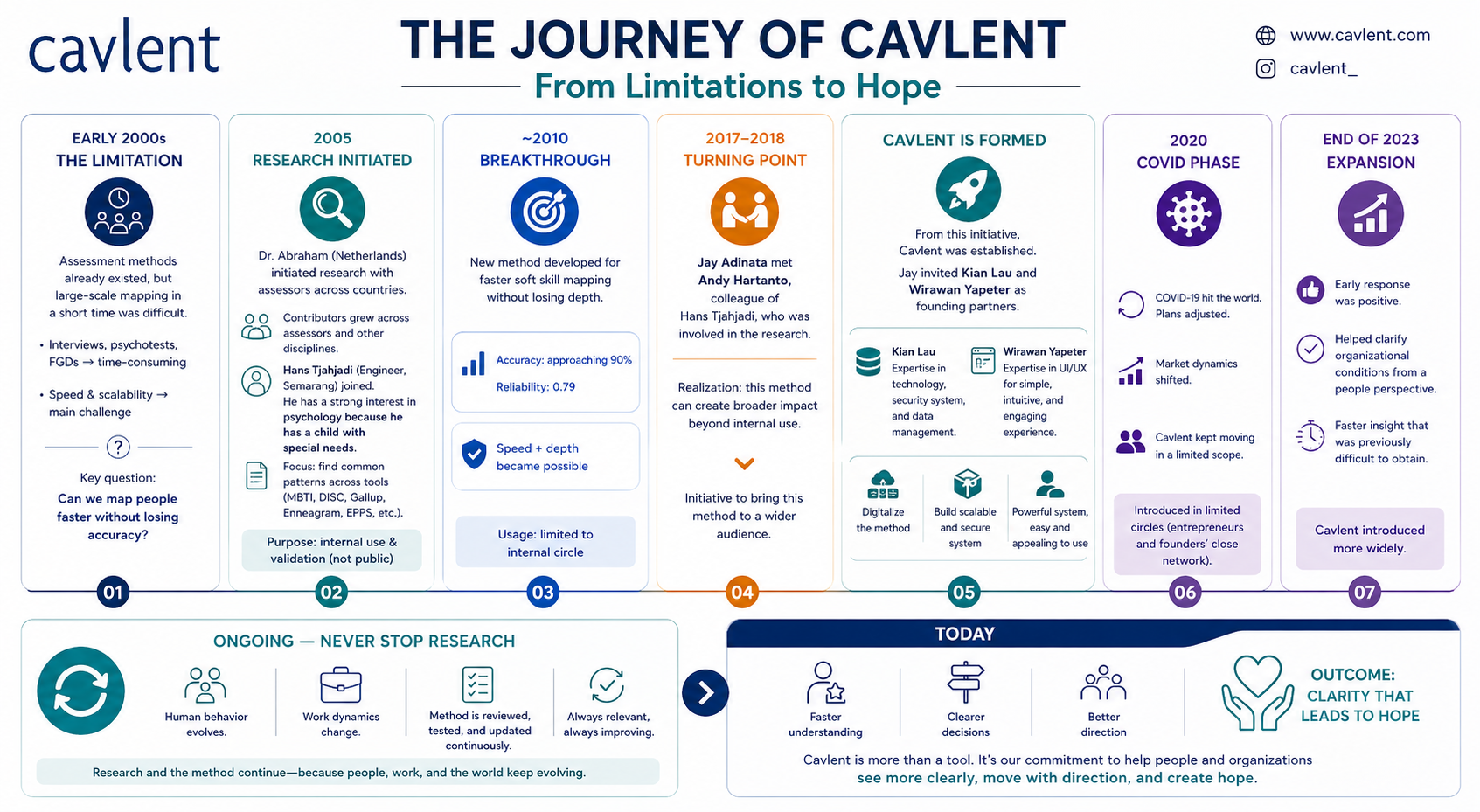
In the early 2000s, the field of assessment already had various methods to understand human behavior. However, in practice, there were still noticeable limitations—especially when large-scale mapping was required within a short period of time.
For certain needs, such as mapping dozens of individuals within days, existing approaches were not flexible enough. Methods like interviews, conventional psychometric tests, and focus group discussions (FGDs) remained relevant, but they required significant time, effort, and lengthy processes. Practically speaking, speed and scalability were still major challenges.
From this context, a simple question emerged: Is it possible to map human behavior faster, without compromising depth and accuracy?
In 2005, a Dutch assessor, Dr. Abraham, initiated a research effort. He did not work alone. He invited fellow assessors from various countries who shared a common interest in advancing assessment methodologies.
Over time, the number of contributors grew—not only from the assessment field but also from professionals in other disciplines who had a strong interest in psychology.
One of the contributors was Hans Tjahjadi, an engineer from Semarang with a deep interest in psychology, partly driven by his personal experience as a parent of a child with special needs.
This collaboration became unique. Assessors with psychology backgrounds focused on understanding human behavior, while the engineering approach helped quantify, objectify, and structure these patterns into measurable frameworks.
They began studying existing assessment tools such as MBTI, DISC, Gallup, Enneagram, EPPS, and others—not to replace them, but to identify overlaps, underlying patterns, and core principles.
It is important to note that from the beginning, this research was never intended for public use. It was driven by curiosity and internal needs—used for validation, exploration, and to support the assessors’ own work, not for commercialization.
Over time, the research began to find clearer direction. Through continuous experimentation and data processing, a new approach emerged—one that could read human soft skills more quickly without losing analytical depth.
Around 2010, this approach had reached a high level of accuracy, approaching 90%. This marked an important milestone. For the first time, it became possible to envision that soft skill mapping did not have to be synonymous with lengthy processes—that speed and accuracy could coexist.
However, the method remained limited in use, confined within the circle of researchers and practitioners involved.
The journey reached a turning point around 2017–2018. Jay Adinata, now known as one of Cavlent’s founders, was introduced to Andy Hartanto, a colleague of Hans Tjahjadi who had been involved in supporting the research.
What started as a brief encounter led to deeper discussions, opening a new perspective: this method was not only conceptually strong but also held significant potential for broader impact.
If it could deliver fast and accurate insights, it should not remain an internal tool. It could help business owners, organizations, and individuals gain clearer understanding of themselves and their teams.
These discussions eventually connected Jay directly with Hans. With his background as a creative and tech entrepreneur, Jay initiated the idea—together with Andy and Hans—to bring this method beyond its limited circle.
From this initiative, Cavlent was established. In this process, Jay was not alone. He invited Kian Lau and Wirawan Yapeter as founding partners.
Kian brought expertise in technology, security systems, and data management—an essential foundation considering Cavlent’s nature of handling databases, data processing, and information security. Meanwhile, Wirawan, who had long collaborated with Kian, contributed strong expertise in UI/UX, ensuring that a complex system could remain simple, intuitive, and engaging to use.
This combination became crucial. Cavlent required not only a strong backend system but also a seamless user experience.
The primary focus of Cavlent was to transform a previously internal method into a modern, structured system accessible to a wider audience.
The digitalization process began. Technological infrastructure was developed, and methods that were previously conducted offline were refined, simplified, and adapted into a more scalable system.
However, during this process, the world faced a major disruption. In 2020, the COVID-19 pandemic occurred. Many plans had to be reassessed, priorities shifted, and market dynamics changed.
Despite this, Cavlent did not stop. The journey continued, albeit within a more limited scope. Early introductions were carried out gradually, mainly among entrepreneurs within the founders’ close network.
At the same time, the research that formed the foundation of this method never stopped. From the beginning, it was never positioned as a “finished” framework, but as an evolving process. As human behavior, work dynamics, and societal contexts continue to change, the method is continuously reviewed, tested, and refined to remain relevant.
The response from this early phase was positive. The method proved helpful, especially among entrepreneurs within the founders’ network. It provided clarity about organizational conditions—particularly from a people and behavior perspective—that had previously been difficult to obtain quickly.
From there, the next step became clearer. Cavlent began to be introduced more widely, especially towards the end of 2023.
From an internal research initiative, Cavlent evolved into a platform that now reaches a broader range of individuals and organizations.
Cavlent was not born from an instant idea. It emerged from real limitations in the field, from curiosity, and from years of cross-disciplinary collaboration—spanning psychology, engineering, and technology.
Today, Cavlent is more than just a tool. It is an effort to help people see more clearly, help organizations move with better direction, and bring something often difficult to find in complex decision-making: Hope—built on clarity.
For decision-makers prioritizing speed and precision, Cavlent is a transformation navigator offering behavior-based team mapping. We identify soft skill mismatches and hidden risks in team dynamics through same-day insights, compared to traditional methods that are time-consuming and rely on manual processes.
For more information, contact: