

A behavioral assessment is the process of understanding how someone tends to work, interact, and stay motivated in a job context — not just what they know or have done before, but how they actually behave when working with others.
For business decision-makers, this answers questions that CVs and interviews often can’t:
Will this person work well within the existing team? Are they ready for a bigger role? What genuinely motivates them — and what could hold them back?
Decisions about people are among the most expensive decisions an organization makes — hiring, promotion, team formation, or restructuring. When these decisions are made based solely on impressions and intuition, the risks are significant. When objective behavioral data is available to complement that judgment, decisions can be made on a much stronger foundation.
Behavioral assessment doesn’t replace human judgment. It’s additional information that helps leaders see aspects of a person that aren’t always visible from daily interaction or a short interview.
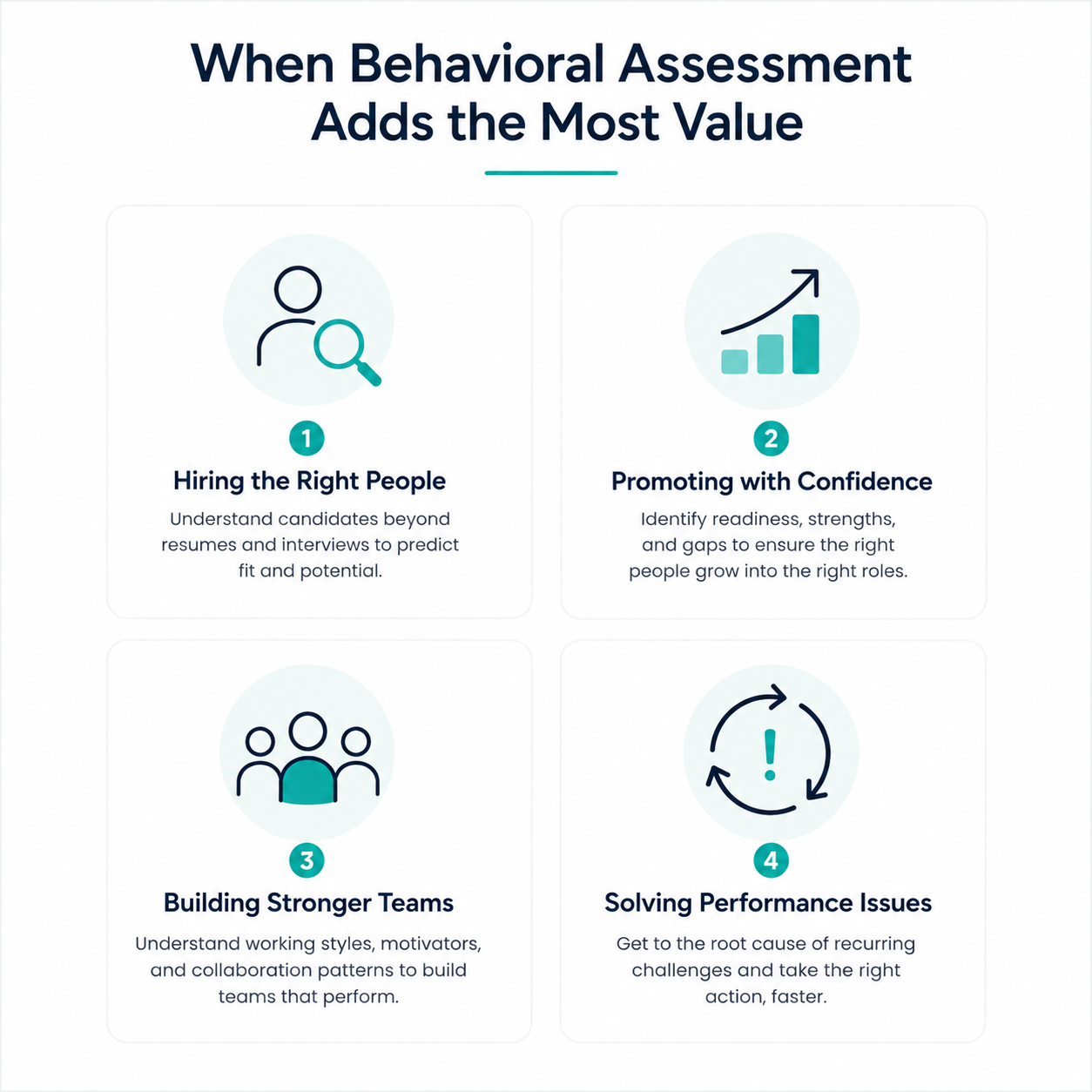
During recruitment — understanding whether a candidate’s working patterns fit the role demands and team dynamics they’d be joining, before the decision is made.
When considering promotion — assessing whether someone has the behavioral readiness for greater responsibility, not just a strong performance track record in their current role.
When building or restructuring a team — understanding the distribution of working patterns and motivation across the team collectively, so decisions about who does what can be more targeted.
When performance problems keep recurring — identifying whether the root cause lies in individual behavioral patterns or in the system and context surrounding them.
Good behavioral data is only useful when read in the right context and used as the foundation for honest conversations between leaders and teams. Not as a final label about someone, but as a starting point for deeper understanding.
Cavlent provides behavioral assessment designed to be directly usable by business decision-makers — in under 20 minutes per person, with insights available the same day.
→ Learn about Cavlent’s behavioral assessment approach
→ Who actually needs behavioral assessment — HR, managers, or business owners?
→ When should a company do a team mapping?
→ Why intuition alone isn’t enough for people decisions
What is a behavioral assessment in a business context?
A behavioral assessment is the process of understanding how someone tends to work, interact, and stay motivated in a job context. For business leaders, it provides objective data that complements intuition and daily observation — helping recruitment, promotion, and team development decisions be more accurately targeted.
Is behavioral assessment only for large companies?
No. For smaller businesses, one wrong decision about a person can have an outsized impact. Behavioral assessment helps business owners and managers make people decisions on a stronger foundation — regardless of organizational scale.
Can behavioral assessment results be used directly to make decisions?
Behavioral assessment data works best as a complement — not the sole basis for a decision. It provides an additional perspective that helps leaders see aspects of a person not always visible from interviews or daily observation, so decisions made are more complete and better-grounded.