

Two teams with identical job structures can produce very different outputs. Not because one team is smarter than the other — but because the combination of work roles within them is different.
A work role is someone's natural tendency to contribute within a team — how they dominantly move, think, and interact when working with others. This is different from the job title or job description formally assigned to them.
Someone with the title "Marketing Manager" might have a dominant work role as a strong executor — highly focused on task completion and operational consistency. Or they might have a dominant role as a strategic planner — more comfortable thinking about long-term direction than daily implementation details. Both can work in the same position, but how they contribute within a team is very different.
① Execution & Operations
People with this dominant role are the drivers of execution — ensuring work actually gets done, standards are maintained, and processes run consistently. They're comfortable with routines, details, and clear responsibilities. Without this role in a team, great ideas often stall at the planning stage.
② Driver & Control
This role pushes the team to move faster, higher, and more measurably. People with this role focus on targets, monitor progress, and don't hesitate to flag when standards aren't being met. They're the team's "rhythm keepers" — without them, teams easily lose momentum.
③ Relationship Builder & Nurturer
This role makes the team function as a team — not just a group of individuals working side by side. People with this role build trust, keep communication healthy, and ensure no team member is left behind or isolated. They're the social glue whose impact is often invisible until they're gone.
④ Strategy & Planning
This role sees the big picture — identifying direction, anticipating risks, and designing long-term approaches. People with this role are more comfortable with abstraction and concepts than implementation details. Without this role, teams can be very busy but moving in the wrong direction.
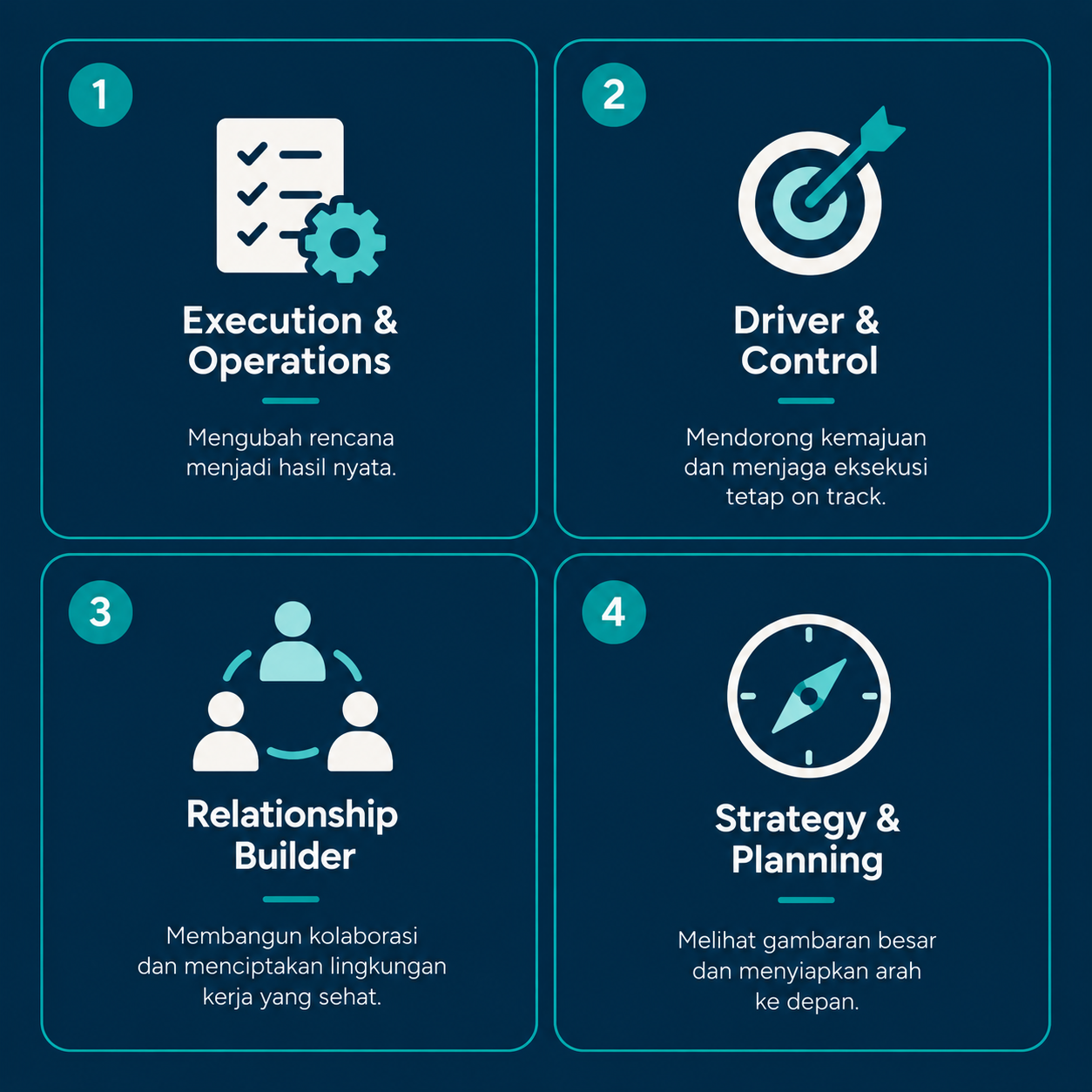
Everyone has all four of these roles — but in different proportions. One or two roles tend to be naturally dominant, while the others are more situational or require more effort to activate.
And no role is inherently better than another. What matters is the alignment between someone's dominant role and the actual demands of their position and the team they're joining.
A team without balanced role distribution — for example, everyone strong in strategy but weak in execution, or everyone strong in operations but no one looking at the big picture — will have recurring unmet needs regardless of how individually competent its members are.
Cavlent helps organizations map the distribution of these 4 work roles in a team collectively — so decisions about recruitment, placement, and development can be made based on a more complete picture of what's genuinely there and what's still missing.
→ Learn more about Cavlent's team mapping
→ Why no team has a perfect composition — and that's not the problem
→ When should a company do a team mapping?
What is a work role in a team?
A work role is someone's natural tendency to contribute within a team — how they dominantly move, think, and interact when working with others. This differs from job titles or job descriptions formally assigned, and more accurately reflects someone's actual behavioral patterns in a team work context.
Can someone have more than one dominant work role?
Yes. Everyone has all four work roles — but in different proportions. Usually one or two roles emerge more naturally dominant, while the others are more situational. Someone with two strongly dominant roles (for example, Execution + Driver) will contribute differently from someone dominant in Strategy + Relationship.
Why is understanding work roles important when building or restructuring a team?
Because the composition of work roles in a team strongly determines its collective strengths and gaps — regardless of each individual's technical competence. A team that's imbalanced in role distribution will keep facing the same recurring problems even when people change, because the root cause is in the composition, not the individuals.