

Many organizations run training programs regularly — but the results aren't significant. Not because the training was poor. Not because the facilitator lacked skill. But because the program chosen doesn't answer the needs that genuinely exist in that organization.
This is a TNA problem — or more precisely, the problem of absent effective TNA.
Training needs analysis (TNA) is the process of identifying genuine development needs at the organizational, role, and individual level — as the foundation for deciding which training programs are most relevant and how to best deliver them.
The key word: genuine. Not the most popular program. Not what's been attended before. Not what a vendor recommends.
One of the most expensive assumptions in people management is that everyone in an organization needs the same development. In reality, when someone isn't performing or developing, the root cause can differ significantly between individuals — and every root cause requires a different solution.
Is the problem in work skills?
Someone may be placed in a position demanding skills that aren't their natural strength. This isn't a motivation or attitude issue — it's misalignment between someone's dominant skills and their role's actual demands.
Is the problem in work attitude?
Skills can fit, but attitude can be the invisible bottleneck. Someone highly procedural and risk-averse will struggle in a role demanding creativity and risk-taking — even if technically competent. No technical training program will fix this.
Is the problem in managerial readiness?
Someone in a supervisor or manager position who doesn't yet have the soft skill maturity for managerial responsibilities needs very different development from someone whose technical skills are already strong. Training the wrong thing only wastes investment.
Is the problem in role mismatch?
Maybe it's not a capability or attitude issue — but a fundamental mismatch between someone's natural tendencies and the role they're holding. This can't be resolved with any training without first considering a role placement evaluation.
Is the problem in unmet motivation?
Someone whose motivation is Appreciation — needing warm, personal recognition — won't be moved by financial incentives or public praise. Unmet motivation is the most commonly invisible root cause, but most impactful on long-term engagement.
Is the problem in information reception style?
A good training program can fail to create impact not because the content is poor — but because the format doesn't match how most participants absorb information. Someone who learns most effectively through direct practice won't absorb much from a training that's entirely text-based and slide presentations.
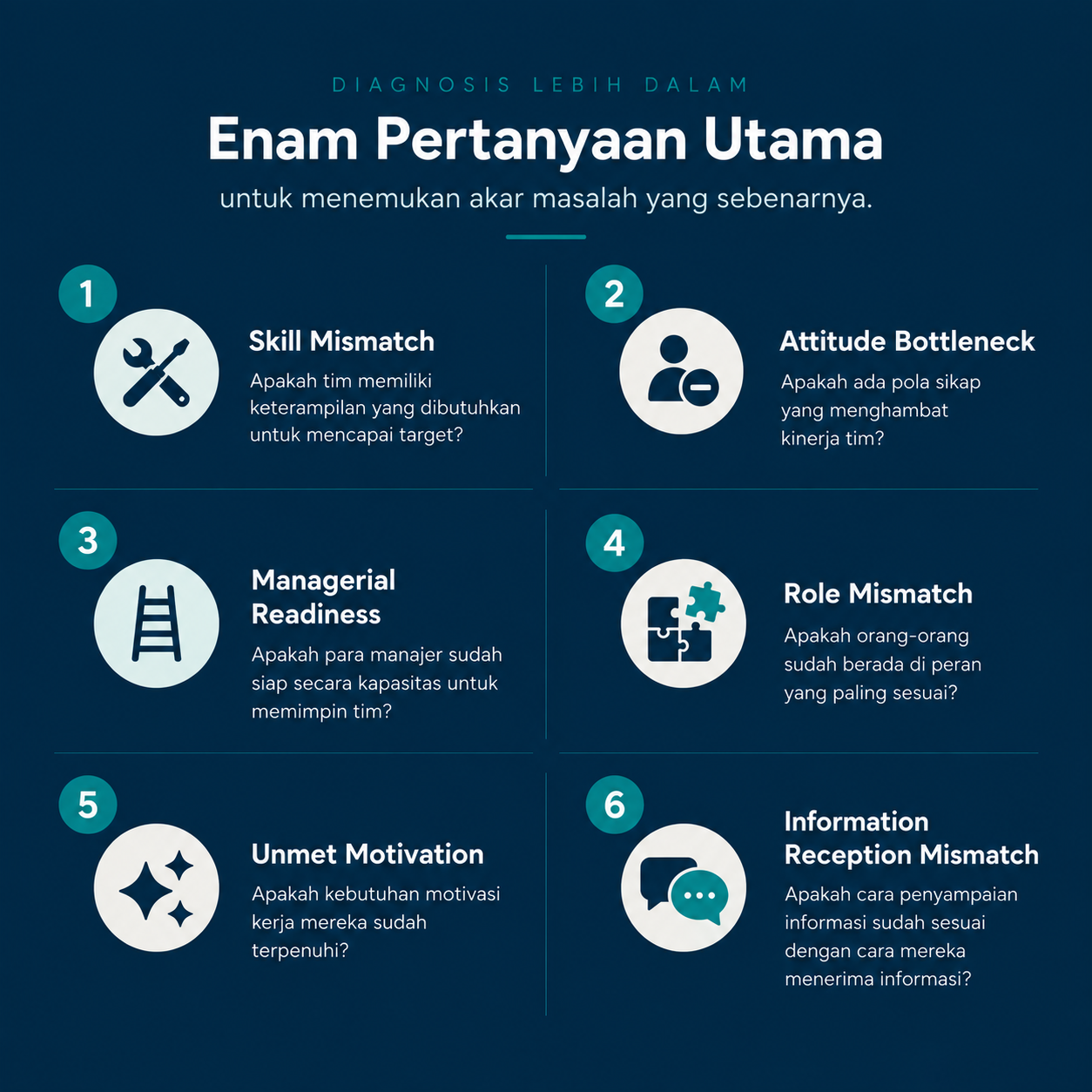
Effective TNA isn't just asking employees "what training do you need?" — answers to this question often reflect preferences or what sounds good, not the actual needs hidden behind performance issues.
Effective TNA requires more objective data — data about each individual's actual condition in terms of dominant skills, work attitude, managerial readiness, role tendency, motivation, and information reception style.
With this data, several key questions can be answered more accurately:
Even the most complete individual condition data won't produce targeted recommendations without clarity about the role context of each individual.
Before starting the TNA process, ensure the following are already in place:
Without this clarity, individual behavioral data will only become an interesting picture that can't be translated into concrete development priorities.
Cavlent helps organizations run behavioral data-based TNA — identifying each individual's actual condition through mapping that takes under 20 minutes per person, with reports available the same day.
→ Learn more about Cavlent's behavioral data-based TNA
→ Why training and coaching insights often don't translate into real action
→ What is skills mismatch — and why it's quietly hurting your business
What is training needs analysis (TNA)?
Training needs analysis is the process of identifying genuine development needs at the organizational, role, and individual level — as the foundation for deciding which training programs are most relevant and how to best deliver them. Effective TNA starts from identifying actual root performance causes, not selecting programs based on popularity or habit.
Why is TNA important before deciding on training programs?
Because root performance causes can differ significantly between individuals — and every root cause requires a different solution. A training program right for a skill problem won't be effective for a motivation problem. TNA ensures chosen interventions answer genuinely existing needs, not assumed ones.
What distinguishes behavioral data-based TNA from conventional TNA?
Conventional TNA often relies on satisfaction surveys, interviews, or direct employee requests — prone to bias and not always reflecting actual needs. Behavioral data-based TNA identifies each individual's actual condition across dominant skills, attitude, managerial readiness, role tendency, motivation, and information reception style — providing a more objective and more directly actionable picture.
Is TNA only relevant for underperforming teams?
No. TNA done proactively — before performance problems exist — is actually more effective because it can prevent mismatches from developing into larger problems. TNA is also highly relevant before onboarding new employees, before team structure changes, or before launching a new product or strategy requiring different capabilities from the team.
How long does the TNA process with Cavlent take?
Each individual completes the assessment in under 20 minutes online. Per-individual reports are available the same day — so needs analysis and program design can begin quickly without disrupting team work momentum.