

“Gen Z these days is hard to manage.” “These new hires want everything fast but don’t want to go through the process.” “So different from how we were at their age.”
Statements like these are common in HR rooms and manager discussions. But look closer — is what’s actually different the generation, or the working pattern?
Generational friction at work is often labeled as an age or generation problem, when what’s actually happening is a difference in behavioral patterns, communication preferences, and work expectations — traits that can be found in any generation, not exclusive to one particular generation.
Labeling based on generation feels convenient. It offers an instant explanation without needing to dig deeper — “well, that’s just how Gen Z is” or “you know how millennials are.”
But this label has a major problem: it lumps together millions of people with vastly different experiences, backgrounds, and personalities, based solely on birth year.
In reality, within the same generation, there are people who love structure and people who love flexibility. There are people motivated by public recognition and people motivated by social impact. The variation within a single generation is often far greater than the difference between generations themselves.
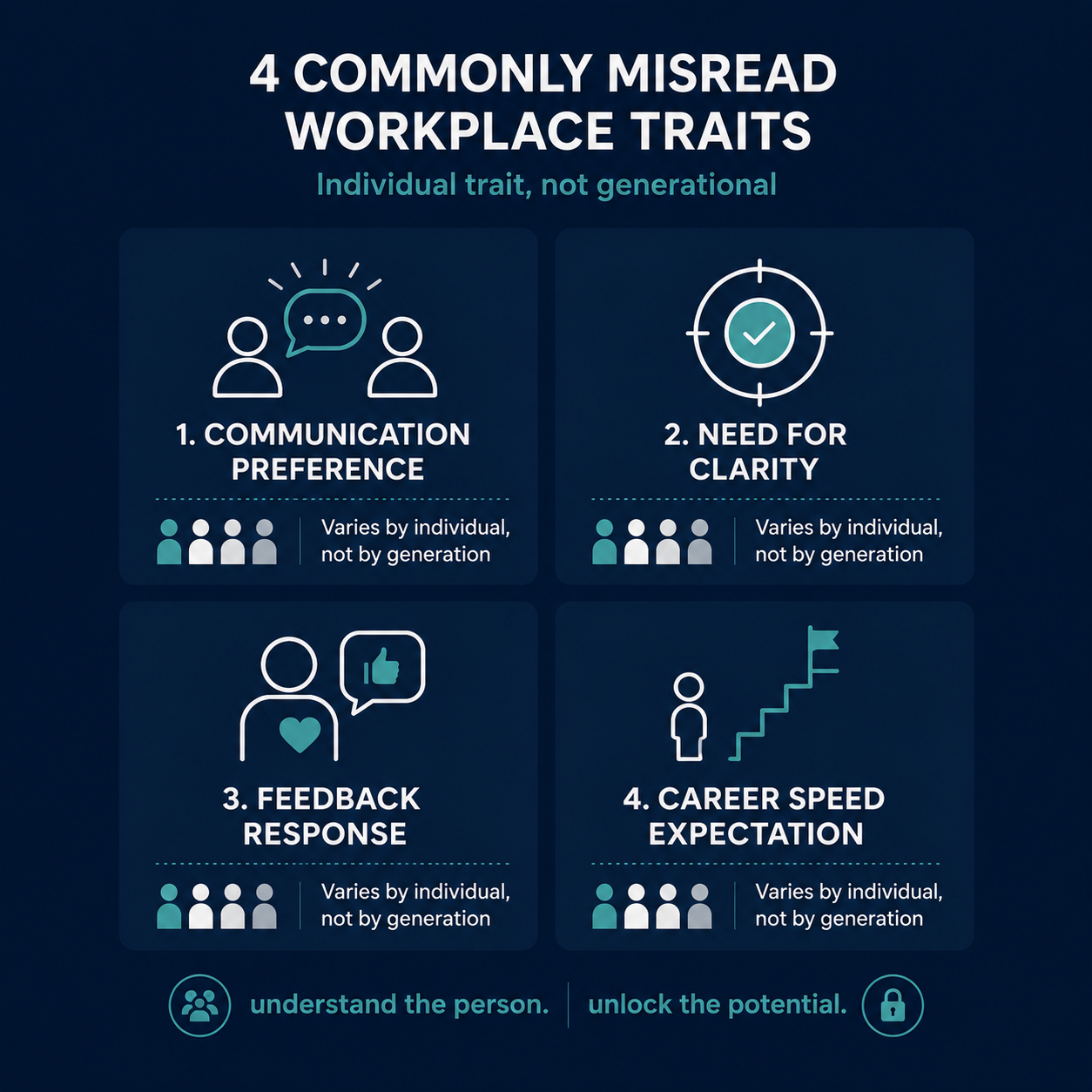
Different communication preferences
This often gets read as “Gen Z doesn’t like direct communication” — when communication preference (direct vs. written, formal vs. informal) is a personal behavioral pattern present in every generation, just distributed differently.
The need for clarity in expectations
This often gets read as “this generation needs everything spelled out, they can’t take initiative” — when the need for structure and clarity is a highly personal work preference, not something determined by birth year.
How someone responds to feedback
This often gets read as “kids these days get too sensitive when criticized” — when sensitivity to feedback and how someone processes it is an individual behavioral pattern that existed long before terms like “sandwich generation” or “strawberry generation” became popular.
Expectations around career progression speed
This often gets read as “this generation is impatient, they want to move up too fast” — when motivation toward achievement and recognition varies enormously between individuals, in every generation.
When differences in work patterns keep getting labeled as a “generation problem,” several risks emerge:
Solutions miss the actual target
If the problem is attributed to “that’s just how Gen Z is,” the solutions designed tend to be generic and fail to address the real root cause — which is individual differences in working patterns.
Individual potential becomes invisible
An employee who actually has a highly structured and disciplined working pattern can have their potential overlooked simply because they “happen” to belong to a generation frequently labeled as “lacking structure.”
Communication across levels becomes defensive
When employees feel constantly labeled based on their generation, they tend to become defensive toward any feedback — because they feel the criticism isn’t about them personally, but about a generational generalization they don’t agree with.
Separate generational assumptions from actual behavioral data
Instead of assuming “new employees must want everything fast,” look at the actual individual behavioral pattern — whether they’re genuinely motivated by quick achievement, or actually by a clear, structured growth path.
Understand each individual’s communication preference, not their generation’s
Some people perform best with very clear, structured instructions. Others are more productive with freedom and room to explore. This is a matter of personal preference, not generation.
Design expectations based on role, not age
Work expectations should be designed based on what the role actually requires and how the working pattern of the person filling it operates — not based on assumptions about which generation happens to occupy that position.
Cavlent helps organizations see each individual’s working patterns, motivation, and communication preferences objectively — regardless of their generation. This data helps shift the conversation from “generation problems” to a more concrete discussion about how each person actually works best.
With this approach, organizations don’t need to guess based on generational stereotypes — they can make decisions based on the actual behavioral patterns each individual on the team possesses.
→ Explore Cavlent’s solutions for cross-generational team synchronization
→ The importance of healthy conflict for generating the best ideas
→ Case study: team mapping summary for a holistic view of collective team patterns
→ If every problem is always the team’s fault, maybe the problem isn’t the team
Are generational differences at work real, or just stereotypes?
Differences in technology preferences or the social context someone grew up in are genuinely real. However, the differences in working patterns, motivation, and how people respond to feedback that often get labeled as “generation problems” are actually individual behavioral patterns, with far greater variation within a single generation than between generations.
Why is the “Gen Z is hard to manage” label harmful to organizations?
Because this label generalizes millions of individuals with vastly different personalities and working patterns, based solely on birth year. This risks designing solutions that miss the actual root cause, and makes employees feel judged based on stereotypes rather than their actual performance or working patterns.
How do you tell the difference between a generation problem and an individual working pattern problem?
Look at whether the observed characteristic is genuinely unique to a specific generation, or can actually be found across all generations with a different distribution. Communication preferences, the need for structure, and how someone responds to feedback are usually individual patterns, not exclusive to one generation.
How do you effectively manage a team made up of multiple generations?
Focus on the individual working patterns and preferences of each team member, not assumptions based on their generation. Design work expectations based on what the role actually requires and the real personal characteristics of the person in it — not stereotypes about which generation occupies that position.
How does behavioral mapping help address cross-generational friction?
Behavioral mapping helps organizations see each individual’s working patterns, motivation, and communication preferences objectively — regardless of their generation. This helps shift the conversation from generational generalization to a more concrete understanding of how each person on the team actually works best.