

Many organizations have beautiful company values written on office walls — but the work culture actually operating day to day is very different from those values. Some know there's a culture problem but can't articulate it clearly. Some design major transformation programs — then wonder why they're not working as planned.
The root of all of this is often one thing: no objective picture of the culture that's actually there.
Culture assessment is the process of understanding an organization's actual work culture — not based on what's declared or desired, but based on data about how the people within it genuinely work, interact, stay motivated, and absorb information.
Organizational culture isn't just about written values or existing policies. It's formed from the accumulation of real behavioral patterns that happen every day — how people complete work, how they respond to pressure, what genuinely drives them to work hard, and how they interact with each other in team dynamics.
When these patterns are collectively mapped for an entire organization, the picture that emerges often reveals something not visible on the surface:
A team that on paper is "collaborative" but whose dominant patterns are highly individual. An organization claiming to be "innovative" but where most members are naturally highly procedural and risk-averse. A company investing heavily in development programs but whose delivery format doesn't fit how most members absorb information.
This isn't a failure of values — it's a gap between desired culture and actual culture. And this gap can only be managed if it's identified with clear data.
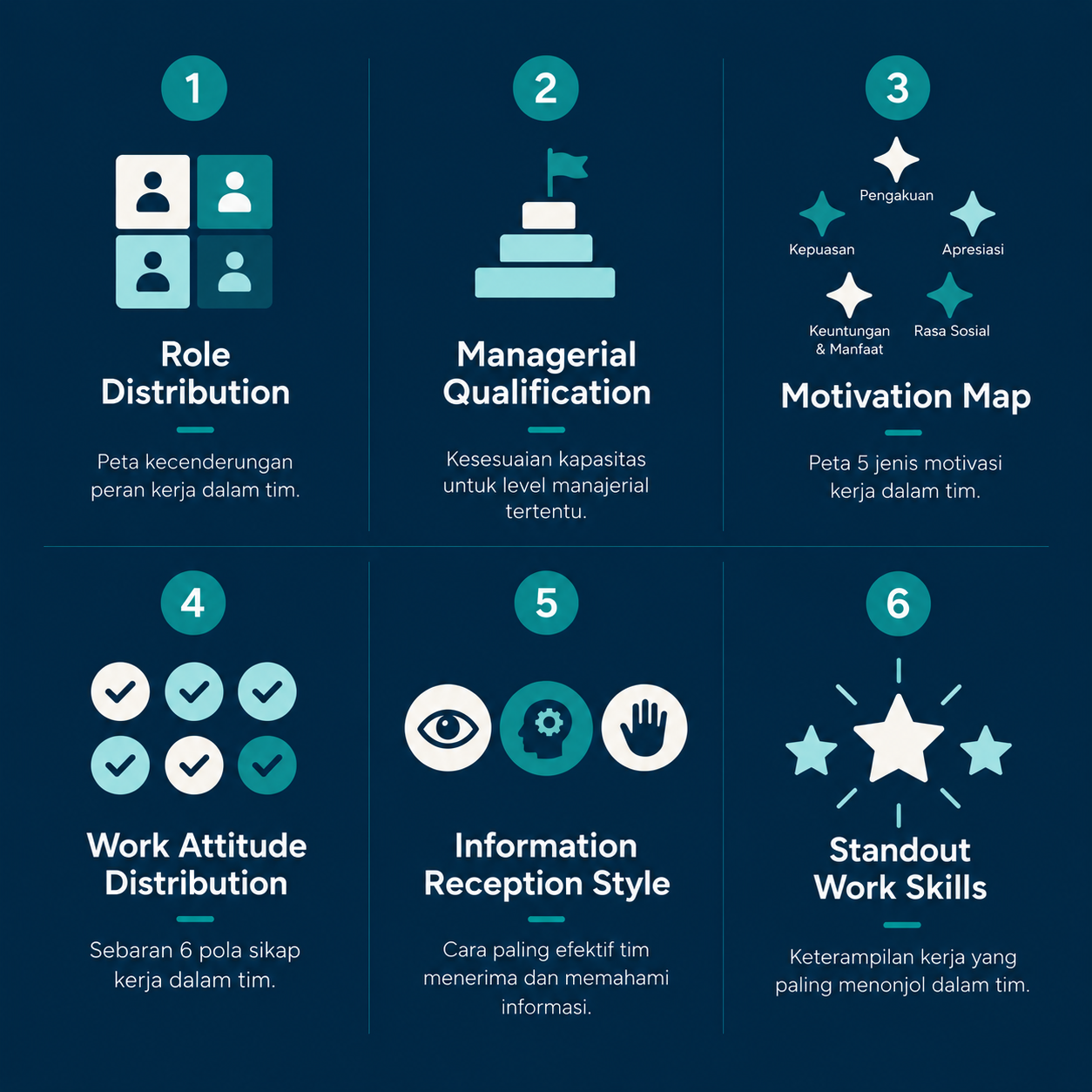
Effective culture assessment doesn't just produce a description of "what culture is like here" — but a mapping that can be directly acted on. There are six dimensions that most determine this:
Dominant work role distribution
How organizational members are naturally distributed across 4 roles: strong in execution and operations, strong in driving and controlling, strong in building and nurturing relationships, and strong in strategy and planning. This distribution determines the collective character of the organization — and whether the composition supports the direction being pursued.
Collective managerial qualification
What proportion of organizational members already have managerial tendencies in terms of soft skill. This is an indicator of organizational readiness for scaling, restructuring, or leadership succession — critical information that's often not captured in data.
Dominant motivation map
Distribution of work motivation types across the entire organization — Recognition, Satisfaction, Appreciation, Benefit & Gain, or Social Purpose. An organization that keeps trying to motivate its team with approaches not resonant with the dominant motivation of its members will keep wondering why engagement is low.
Dominant work attitude distribution
6 attitudes forming actual culture: task completion, target focus, verbal communication, collaboration, self-development, and rule adherence. The dominant combination of attitudes — not the declared ones — is the mirror of the culture actually running.
Information reception style
How organizational members most effectively absorb information — through text, visual, audiovisual, literal language, figurative language, direct practice, or fine motor. This data determines how internal communications, SOPs, and training programs should be designed — to be genuinely absorbed, not just delivered.
Collectively prominent work skills
These are collective strengths that can be maximized — and simultaneously a mirror of gaps that need filling to support strategic goals.
Before designing a transformation program
Transformation that doesn't account for actual cultural conditions almost always faces unnecessary resistance. Culture assessment provides a clear picture of where the organization actually is — so change programs can be designed realistically, not based on ideal conditions that don't exist.
Before expansion or opening new units
Ensuring cultural and managerial readiness before the organization moves to a larger scale. Expansion done before the cultural foundation is strong often creates problems far more complex than anticipated.
During leadership transitions
A new leader entering without understanding the actual culture already in place risks creating unnecessary friction. Culture assessment data provides orientation far more accurate than just first-week observations.
When performance stagnates without clear reason
When all operational indicators look fine but the organization isn't moving, constraining cultural patterns are often the invisible root. Culture assessment helps identify this without relying on opinion or assumption.
Before designing TNA or training programs
Data on dominant motivation and information reception styles from culture assessment is the foundation determining whether training programs will genuinely be absorbed or just run as obligation.
There is no "ideal culture pattern" that applies to all organizations. Effective culture assessment doesn't judge existing culture as good or bad — it reveals what's actually there, so decisions about what to retain, develop, or change can be made more consciously.
What determines whether culture assessment data can be acted on isn't just data quality — but how clearly the organization has already defined where it wants to go. Without strategic clarity and clear goals, culture mapping data will only become an interesting picture that's never followed through.
Cavlent helps organizations run culture assessment through collective mapping of all members — with a process taking under 20 minutes per person and a collective picture available the same day.
→ Learn more about Cavlent's Culture Assessment
→ If every problem is always the team's fault, maybe the problem isn't the team
→ When the data is already there, but change still doesn't happen
What is a culture assessment?
A culture assessment is the process of understanding an organization's actual work culture — not based on declared values, but based on data about how people genuinely work, stay motivated, and interact. The result is an objective picture of the actual cultural condition — as the foundation for more realistic transformation, development, or leadership change decisions.
What's the difference between a culture assessment and an employee engagement survey?
Employee engagement surveys measure feelings and satisfaction at one specific moment — prone to bias and easily influenced by immediate context. Culture assessment measures more consistent actual behavioral patterns — how people genuinely work, what truly motivates them, and how information is absorbed — providing a more stable and actionable picture.
How long does a culture assessment take?
Each organizational member completes the assessment in under 20 minutes online. A collective picture of the entire organization is available the same day after all members complete their input — no days of waiting like conventional assessment processes.
Is culture assessment only for large organizations?
No. For smaller organizations, understanding actual cultural patterns early can prevent problems far larger in the next growth phase. Clear cultural data is valuable whenever an organization is considering change — whether at a scale of 20 people or 200.
What distinguishes effective culture assessment from ineffective?
Effective culture assessment doesn't just produce a culture description — it identifies actionable gaps. It also needs to be read in the context of already-clear organizational strategy and goals: without that, cultural mapping data will only become an interesting picture that produces no concrete decisions.